
‘Power Ballad’ Review
Armed with catchy original music, a charismatic cast, and relatable themes of family, love, and the relationships that foster creativity, John Carney rarely breaks the mould he’s created for himself. It’s a comfortable place for Carney where he can work within a familiar framework while still exploring a variety of characters wrestling with the artistic pursuit. While his latest film, Power Ballad, continues to feel overly familiar in almost every regard, it also confronts the idea of universal resonance as more than just writing about the relatable. The writer-director’s palatable approach to the music film untangles the sacrifices we make from the emotions that drive us to where we are today.
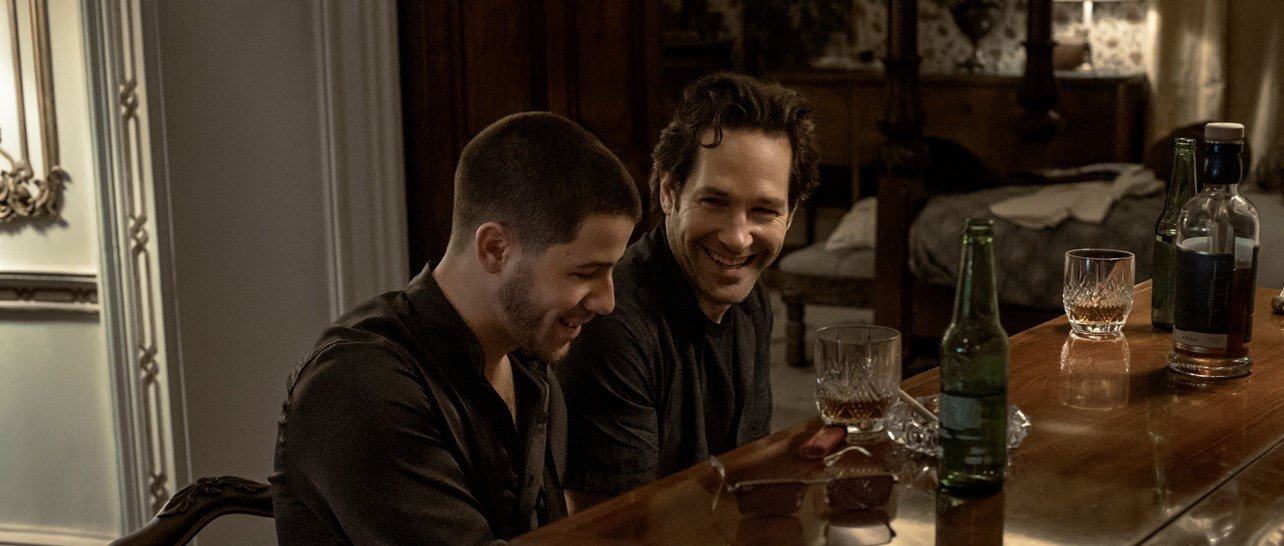
It’s easy to look at the frontman of a wedding band and only see a road paved with lost ambition. Thankfully, Carney presents Power Ballad’s protagonist, Rick (Paul Rudd), as a musician who hasn’t fully lost that creative spark. Writing songs on the side as he fronts a covers band for weddings, he can’t quit writing music even if it seems unlikely that they’ll ever find him fame and fortune. When a chance encounter with former boy-band-member-turned-solo-songwriter Danny Wilson (Nick Jonas) stokes those artistic fires, his dreams slowly start turning sour when their impromptu jam session results in one of Rick’s songs being stolen by Danny and turning Danny’s career into the comeback Rick always dreamed of.
While Power Ballad ultimately pursues its legal-drama plotline a little too much, what emerges is some of the most emotionally rewarding soul-searching in a Carney film. As Rick pursues trying to get the credit he rightfully deserves for Danny’s breakout hit, it becomes increasingly clear that he’s not necessarily in it for the money. Though there would undoubtedly be compensation involved, Rick is on a quest for validation; that the path he chose was not destined to end as the frontman of a wedding band, but could only exist by being there for his family over everything else. An ex-pat from the United States who moved to Ireland to build a family with the love of his life, Rick is always looking for validation that he made the right calls in life. Not that he regrets the ones he has made, but it is clear that something tugs at him when he hears his song on the radio. Juxtaposed against Danny, who is fighting to break through to a career that may not be the right move, Rick’s legal drama over the intellectual property rights to his song is more personally motivated than financially driven.
Power Ballad, more than some of Carney’s other films, feels like it contrives a few plot points too many to create something narratively clean amid the inherent mess of the plot. Support systems turn away to create dramatic moments, while others are supportive in their own potentially destructive ways. However, none of the tension ever feels more than superficial. It has always been the tricky balance for Carney’s screenplays. Every attempt to walk close to the breaking point is mired in saccharine storytelling. The honesty of his screenplay, this time co-written with Peter MacDonald, often cuts through that, but when it pushes up against contrivances that feel like a slight betrayal of the characters, it can be a struggle to see the sincerity.
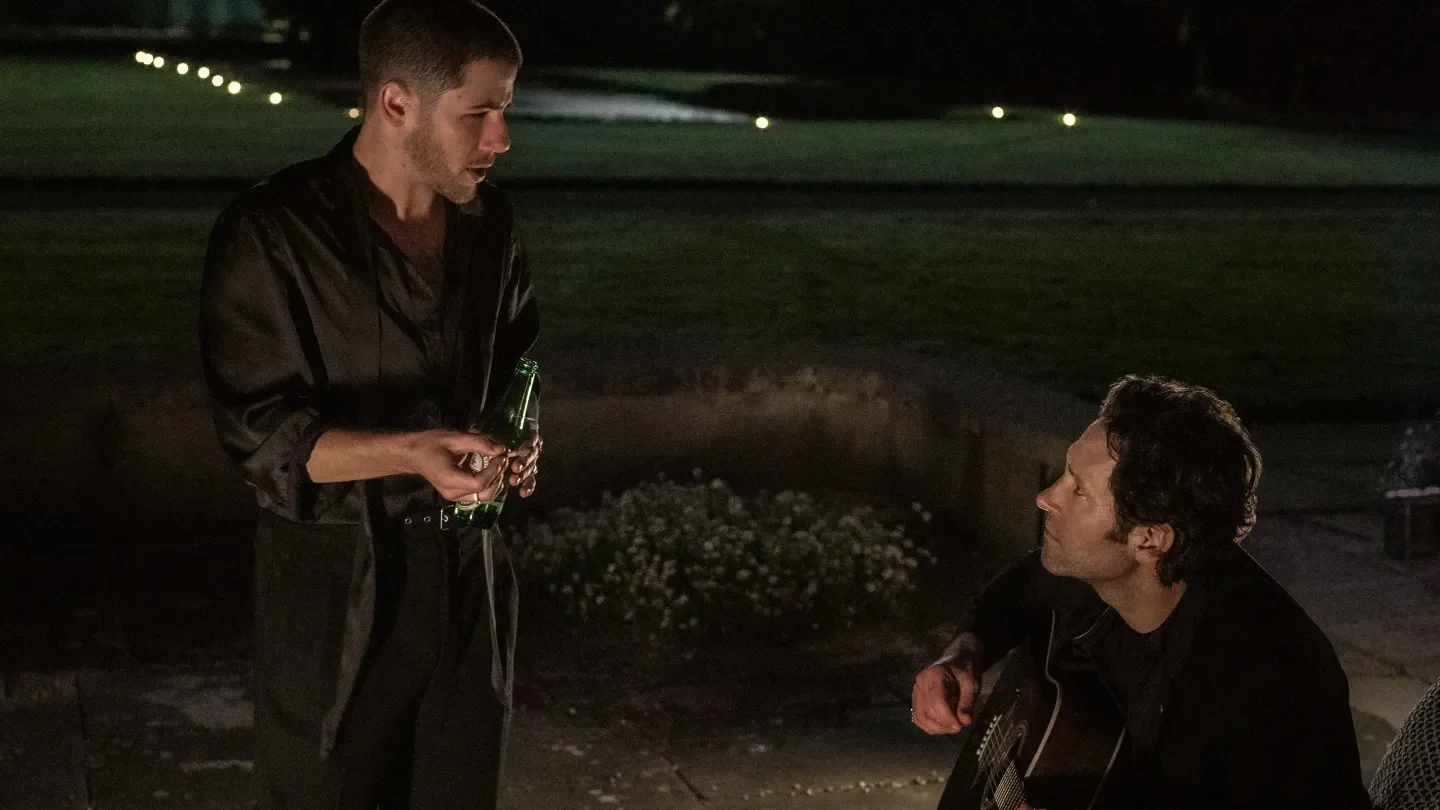
Fortunately, the film is cleverly constructed around its central original song, “How to Write a Song (Without You)”, which is one of Carney’s most infectiously sweet songs. Co-written by Carney and frequent collaborator Gary Clark (whose “Drive It Like You Stole It” remains in rotation in this household), it’s an intimate, catchy song and the lynchpin of the entire film’s emotional being. What it means to one character can mean something completely different to another, and it’s because of that adaptability that it holds so much power. It wasn’t until I walked out of the theatre and thought back to the film’s untangling of family and art that I realized the film had gotten its point across. For as loudly sentimental as the film can be, it has a subtly profound impact that lingers well after the credits have rolled.
The chemistry between Rudd and Jonas helps colour the initial meet-up in a way that makes everything that transpires afterwards genuinely feel like a schism between business and personality. As Danny’s manager, Mac (Jack Reynor), guides Danny through the legal fortifications required to keep face during Rick’s allegations, it does feel like Danny is slightly trapped under the weight of expectation and ambition. Providing that little bit of empathy towards Danny and somewhat understanding Mac’s position from a business perspective keeps Power Ballad’s conversations about artistry within an industry designed around commercializing soulful creations on the fringes of the core narrative. Also on the fringes are Rick’s family and friends, from his wife, Rachel (Marcella Plunkett), and daughter, Aja (Beth Fallon), to the wedding band, which includes one of his most devoted friends, Sandy (Peter MacDonald). While the cast is fun and MacDonald maybe gets the most sizeable supporting role in the film, there’s way too little done with them to really appreciate their perspectives on Rick’s dilemma. Which, unfortunately, is what results in those more sudden character moments feeling contrived.
As predictable as a Carney film can be, Power Ballad carries more cynicism for longer than expected, given how the film sets things up. It’s still playful, and occasionally gives way to that sliver of optimism that things might work out, but the film dodges a lot of predictability by simply wallowing in the minutiae of its legal predicament. It’s a complicated conversation that the music industry likely faces on a regular basis. For many young songwriters trying to escape the endless busking, it’s also a pretty stark depiction of the grind only endurable under the right mindset. That goes for virtually every creative industry. Power Ballad sees the pursuit of artistic freedom for what it is: a soul-enriching experience that seems to be financially rewarding only to a few lucky individuals. It’s a celebration of what music can mean under the right circumstances, and of how letting go of the failure to operate by a single metric can be the liberation needed to create art that strikes a more powerful chord.
