
NYAFF 2026: ‘Colony’ Review

It has been a while since Yeon Sang-ho dived deep into the zombie genre, despite working on many films and TV projects since 2016’s breakout success, Train to Busan. An emotionally charged barnburner of a film that moves quickly while juggling multiple character arcs to satisfying conclusions. It’s a feat of genre filmmaking that found international success thanks to the care and attention it put into making a spectacle of both its action and narrative. Making his return to the genre, Yeon has dabbled in so many ideas and concepts from an extended foray into direct-to-streaming projects that his latest film, Colony, utilizes to remind audiences that the zombie film still has a lot of life left to give. A menagerie of sticky substances and stickier situations, Colony is a clever approach to a subgenre that circles familiar beats with thoughtful execution.
Mob mentality and a hive-mind society are at the forefront of Yeon and Choi Kyu-seok’s screenplay. The ease with which a single idea can take hold and unify an entire population, and what that looks like when others are still resisting homogeneity. Much like the similar singular behaviours of the undead, Colony takes the conformed masses of infected a bridge further by literally connecting them all through neurological means. When disgraced researcher Suh Young-chul (Koo Kyo-hwan) calls in a bioterrorist attack at his former employer’s office building, he also injects himself with the only known cure to the virus he’s about to unleash on the unsuspecting public. His first target? The CEO who stole his ideas and ostracized him from the scientific community.
An infection that spreads rapidly through the typical bite of someone already infected, Colony becomes interesting once its usual flesh-eating monsters become weapons for its creator. With the building locked down, the few survivors left are forced to work together to keep everyone alive while also capturing Suh and bringing him to the roof for extraction. That’s easier said than done when self-preservation gets in the way, which eats at the tenuous bonds connecting everyone simply looking for an escape from the madness. It’s your typical zombie movie cliché as a group of unlikely heroes find themselves at odds with each other in the face of certain doom, but by bluntly positioning that discord against the unified purpose of an undead mob, Yeon turns the premise into a smart reflection on how difficult it is for humanity to truly be virtuous.
The idea of collective intelligence looms over the film and is embedded in the DNA of Yeon and Choi’s script. Comparing the mass of infected humans to ants, the film immediately makes clear the lack of individual thought in humanity and the ease with which society tumbles towards certain ideas, unaware of the cost of its actions. The most striking element of Yeon’s depiction of this is the film’s use of a white, stringy substance that seems to excrete from the infected and plaster itself over the walls, floors, and the infected themselves. It turns the slick interiors of the office building—housing a mall at its base that hosts some fun sequences—into a nightmarish hellscape reminiscent of H.R. Giger’s grotesquerie. It’s a nice touch that gives Colony a unique identity among its zombie-movie brethren.
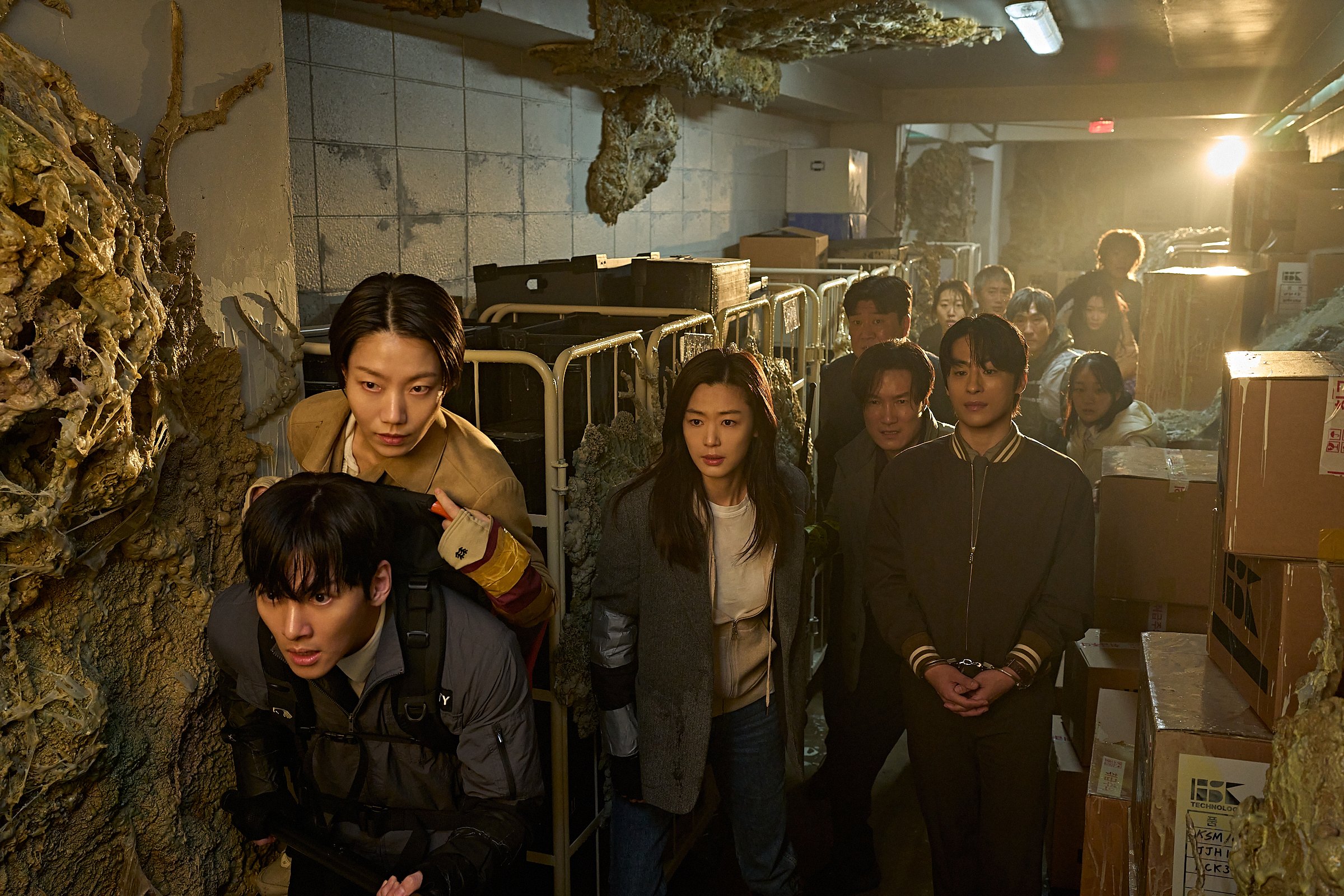
A zombie film is nothing without an endearing cast of characters, and while Colony has some notable standouts, it is not without its missteps. Much like Train to Busan, the film’s effectiveness as a survival thriller hinges on compelling emotional arcs among characters who face friction due to the circumstances threatening them. The only relationship that feels fully realized and satisfying in its climax is between security guard Choi Hyun-seok (Ji Chang-wook) and his wheelchair-bound older sister, Choi Hyun-hee (Kim Shin-rok). The two are not major characters, but their chemistry and arc are more emotionally resonant and leave a stronger impression than those of the characters surrounding them.
Much of the disappointment stems from Yeon and Choi’s screenplay leaning on bleak subversions of expectations just as often as it does bleak realities. While Jun Ji-hyun gives a great performance as the unemployed scientist-turned-leader, Kwon Se-jeong, it’s also a performance burdened with doing more than the screenplay provides for her character. She gets tied up in a few dynamics, and all of them feel squandered or rushed by the screenplay. The result is a fumbling of the thematic material once the film starts winding down. Every other character fulfills some self-preserving archetype, from the selfish businessman to a cop who will secure the vaccine at any cost to a teenager trapped with her bully—it’s all people who are thinking about themselves and how they will get out, without really caring about those around them. This is the point of Yeon’s film, but it leaves a dour, repetitive film in its wake.
Despite that, Colony has an energy, briskness, and creativity that keeps it entertaining even when it’s revelling in familiar genre trappings. Practical effects go a long way toward making the zombies appropriately disgusting and terrifying, and the performers—caked in makeup and prosthetics—turn a horde of monsters into something that feels truly unstoppable. Neat flourishes, like mimicking what they see and the film’s constant tension in keeping its host unaware of the survivors' whereabouts, help flesh out the mechanics while keeping audiences on their toes. The sinewy nightmare that adorns the halls of the building the film’s survivors are forced to escape adds to an almost-suffocating atmosphere of hopelessness. The feeling that a situation can go sideways from one small mistake leaves Yeon’s film walking a tightrope of intelligent behaviour and good old-fashioned monster thrills, though it does unfortunately veer into the latter more often than it should.
While Yeon can’t help but play it safe in some regards, there’s still an unbridled energy to Colony that reinvigorates the film whenever it seems like it’s on the downswing. Standout performances from Ji Chang-wook, Jun Ji-hyun, and Koo Kyo-hwan elevate some antiquated material, and the film’s clever approach to zombies makes for an entertaining exploration of their mechanics. While it doesn’t quite stick the landing with its thematic and narrative threads, Colony’s kinetic filmmaking, disgusting makeup and production design, and visceral action turn Yeon’s latest into a gnarly slice of entertainment worth experiencing simply for the thrill of it.
The 25th New York Asian Film Festival takes place between July 10th and 26th. Colony celebrates its North American premiere on July 10th as NYAFF’s Opening Night film. The full list of films selected for the festival can be found here.
