
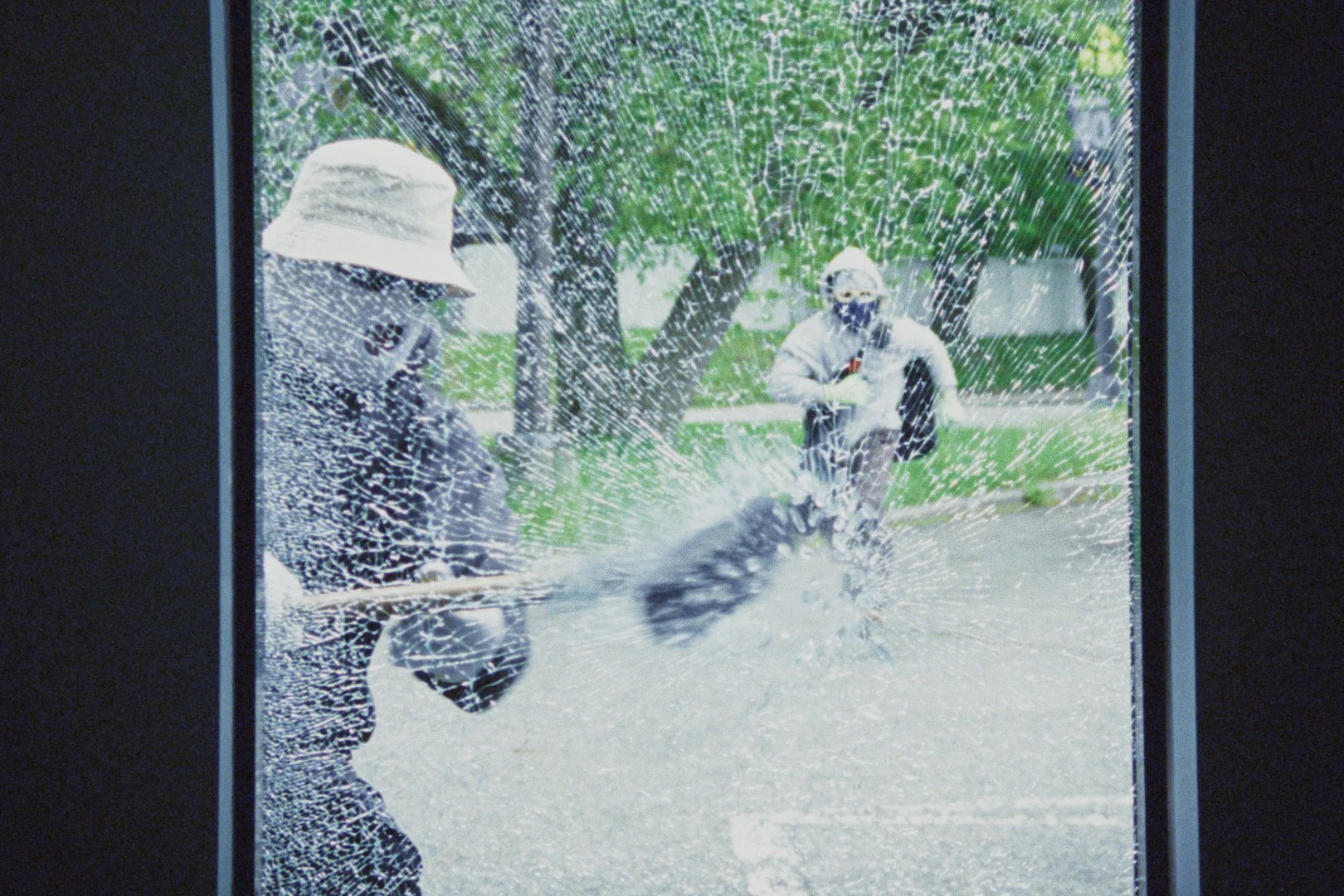
“This is almost a true story,” opens Rémi St-Michel’s criminal coming-of-age film, Toy Gun Bandit. While the events that transpire can feel too difficult to believe at times, St-Michel’s screenplay lets its more dramatic bursts of energy gloss over the grim realities of its characters. St-Michel’s latest plays out like a Québécois version of Josh and Benny Safdie’s electrifying Good Time. At the same time, it reflects a growing concern about youth prematurely thrust into adulthood after hitting rock bottom—a generation that turns to crime at an early age, only to find itself on the fringes of society, doing whatever it can to make ends meet and support the ones it loves. Toy Gun Bandit wields a surprising heft to its anxiety-inducing momentum, turning cheap thrills into a socially conscious examination of capitalism destroying innocence.
For the film’s 15-year-old protagonist, Félix (Félix Munger), the world is his oyster. But without proper guidance, that future can suddenly crumble at the drop of a hat. That’s where Félix now thrives, after a prank gone wrong leads him to successfully hold up a convenience store and get away with stealing alcohol on his birthday. His path crosses with Dave (David Beaudoin), a wannabe gangster trying to help his wife, Jenny, and their child cut financial ties with her disapproving parents. After roping the drug-addicted Sara (Sara Montpetit) into their plan, the trio begin robbing banks without any prior experience. As their ramshackle approach starts ironing itself out, the three find themselves in way over their heads as their fortunes garner increased attention and Félix’s childhood quickly slips away from him.
Toy Gun Bandit is surprisingly emotional by the time it wraps, but it does hit familiar beats to get there, which can feel a little tedious at times. St-Michel demonstrates an impressive sense of direction, especially when paired with Munger’s compelling debut performance. He makes Félix into a character that you feel sympathy for, root for, and ultimately wonder if there’s any hope of digging himself out of his predicament. Surrounded by adult figures who might not have his best interests in mind, Félix becomes someone who you want to protect but feel like there might not be any chance of doing so. With intimate cinematography made propulsive by St-Michel’s editing, Toy Gun Bandit does a lot with its simple premise as it barrels toward a satisfyingly sombre conclusion.
The 51st Toronto International Film Festival takes place between September 10th and 20th. Toy Gun Bandit celebrates its World premiere on September 10th as part of TIFF’s Centrepiece program. You can find the full list of films selected for the festival here.

Life and death hold a magnitude that cannot easily be dismissed in Nobody’s Violence. Genre-bending in execution, but ultimately all stemming from the same source of vitality, Denis Côté’s latest film celebrates life in all its complexity as an enigmatic woman helps individuals commit suicide. Seen as an act of kindness, Mira (Larissa Corriveau) goes from client to client, helping them end their lives. However, after meeting an outgoing individual who seems untethered from life's grim realities, she begins to question her work and the charismatic boss (Philippe Rebbot) who demands it continue unabated. While undoubtedly striking in its visual compositions of distant emotions rivalling the joie de vivre that threatens the muted approach to Mira’s work, Côté’s film slowly gives way to an uninteresting narrative that clings to stylistic changes for excitement.
The film’s most exciting quality is its aesthetic: shot on 16mm with a drab colour palette, Nobody’s Violence sets a tone with just its visual styling alone. Mira’s cold, distant personality is only rattled by intensity, and Vincent Biron’s photography mirrors that by closing in on characters as they reckon with something profound. Sleeping in her van and drifting between contracts, it’s only when Mira is confronted by the reality of what death means to those around the dying that something seems to stir inside her. When she meets Pierric (Xavier Bergeron) at an outdoor rave, her outlook on life seems to shake; contrasted with the hedonistic, brutally detached people who work alongside her, she's disturbed by what death means to those who profit from it. An early attempt to find a home for her dog, Mario, accentuates the grim acceptance by some that death is nothing more than a solution to a problem.
There’s a weight to death, and that’s what Nobody’s Violence tries to uncover through its experimental approach. Its minimalist dystopian production design presents a world where the end of a life seems like a commonality, but what Côté’s film interrogates is whether accepting death can be normalized without losing something in the process. It’s got a tinge of disaffected science fiction that then shifts to mirror Mira’s outlook on life itself. Corriveau’s performance throughout is mesmerizing, but it’s holding together a movie that is more aesthetically compelling than narratively robust. There’s not much foundation built to bear Côté’s swings, and the characters who are interesting are also bluntly realized. Nobody’s Violence simply doesn’t have the bones to support such a striking vision.
The 51st Toronto International Film Festival takes place between September 10th and 20th. Nobody’s Violence celebrates its North American premiere on September 11th as part of TIFF’s Wavelengths program. You can find the full list of films selected for the festival here.
