
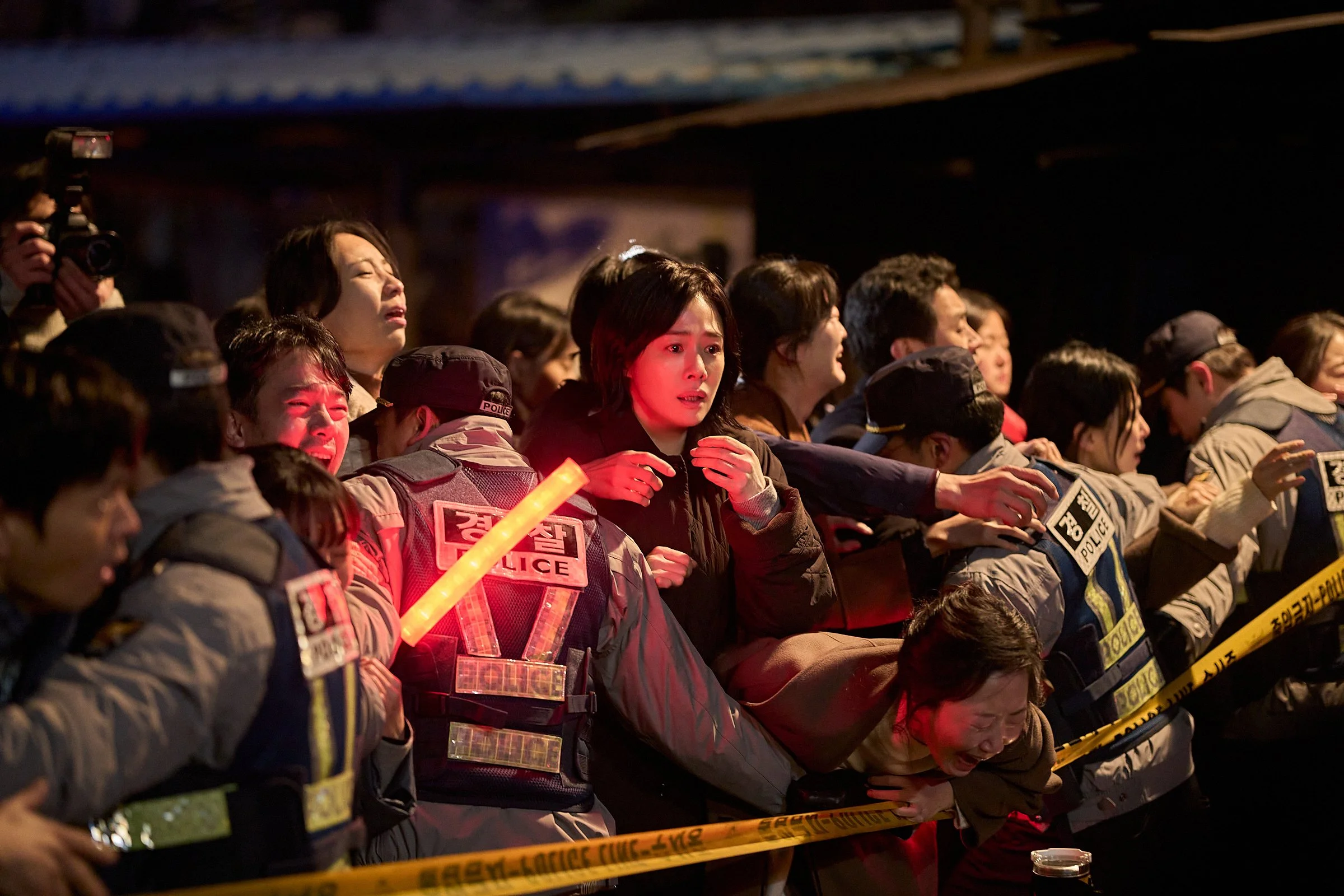
Grief and reckoning with that loss have always reared their heads in some fashion throughout Yeon Sang-ho’s work. More specifically, he seems fascinated by how people cope with tragedy. Whether it’s a zombie outbreak, an unexplainable tragedy, or the mounting tensions of grief, Yeon’s filmography has consistently explored people torn apart and forced to make sense of something terrible. That’s exactly what the parents of thirteen missing children are faced with in Yeon’s latest thriller, Paradise Lost. In his second film of this year, the director continues to navigate interesting ideas about technology’s intersection with our lives, but muddles the impact with a twist-heavy narrative that never lives up to the film’s promising premise.
Reckoning with technology’s role in mourning, Paradise Lost explores how artificial intelligence and augmented reality can obscure the pain rippling through the coal-mining town of Musan. When the missing children’s fates seem more than certain after the discovery of five dead bodies and the alleged murderer being found at an abandoned coal mining site, their parents become hollowed out by the understanding that their missing children are likely dead. Ryu So-young’s (Kim Hyun-joo) son, Sun-woo, is one of those children whose fate is uncertain. When TransHuman—an AI company—offers to build an app that lets grieving parents talk to a virtual version of their child, So-young immediately takes the opportunity.
Titled ‘Children of Paradise,’ the app is intended to be used temporarily to help parents move beyond this particularly tumultuous stage of their lives. It requires the user to wear glasses that augment reality so the child seems to be in the room with them, but they can’t be touched and only appear when the glasses are on. Nine years later, So-young still uses the app and has integrated the visits into her daily routine. However, when a stranger appears claiming to be Sun-woo (Bae Hyun-sung), she’s forced to confront the reality she’s built for herself with the one standing in front of her. That’s easier said than done, though, as So-young begins to notice that this adult version of Sun-woo, while similar to her child in certain behaviours, also seems to be more violent and less approachable.
What transpires over the course of Paradise Lost is not too surprising given how much the audience is challenged to accept this stranger as Sun-woo. Yeon and Ryu Yong-jae’s screenplay focuses heavily on So-young’s dependency on the Children of Paradise app, which creates tension between her and Sun-woo when he returns. A mother clearly unable to accept the new reality dives deeper into one of digital ghosts and uncorrupted memories. As that addiction grows, So-young’s distance from reality threatens the tangible, human relationships that desperately need her attention. A broken son and a distant mother—the former of whom has lived 9 years in harsh conditions without a parent figure, and the latter of whom refuses to leave her memories behind.
The pain of the situation is intense, especially given how much Yeon’s direction wallows in that fractured relationship, keeping Sun-woo in grungy-looking environments while the child version of him is in empty, sterile spaces kept spotless. They are two isolated versions of one person: one abandoned and one caged. That’s an interesting relationship and ultimately is what makes Paradise Lost fascinating to untangle, especially when the film starts leaning more into how the technology behind Children of Paradise works. There’s something creepy there, but it feels like Yeon is mostly interested in how technology supplements human needs, rather than the evolution of that technology—likely because that evolution will come as human needs adapt. Kim continues to deliver performances that meet Yeon’s vision, bringing empathy to a mother who should be caring for her son in front of her but can't comprehend the changes in her routine.
If Paradise Lost wasn’t so committed to being surprising or thrilling, it could have been a much more interesting film. The procedural elements of Yeon’s film feel like happenstance as journalist Oh Kyung-won (Lee Hyun-gyun) begins investigating Sun-woo’s sudden reappearance, unbeknownst to So-young. It’s a storyline that adds mystery around Sun-woo and what happened to him during those nine years—and why he's the only kid who survived—but it also doesn’t really introduce an interesting character or do anything particularly innovative. It’s your traditional crime thriller with an unsavoury character at its helm. Many of the decisions surrounding Sun-woo are designed to intensify the creepy aura around him. A drab atmosphere suffocates the entirety of Paradise Lost, but it’s the decision to play up more traditional thriller elements and ultimately obfuscate the truth about Sun-woo that drags down the film’s effectiveness.
Paradise Lost raises real concerns about virtual spaces becoming an addictive step in the grieving process. That mourning can still mean being able to talk to a virtual version of the person you’ve lost is a complicated matter to explore. Yeon and Ryu’s screenplay is tightly written, even if some elements feel unnecessary. Everything connects back to how broken the relationship between So-young and her son has become, and whether she is willing to cross lines to bridge that gulf. It’s a bleak film, wrapped in such an unpleasant package that its late-game decision to pile on shocking turns of events leaves a cheapened version of the otherwise thorny investigation into grief in the digital age. Yeon continues to prove he’s a gifted genre filmmaker with plenty of headier ideas on the table. However, he often can’t juggle them both without muddying the execution.
The 51st Toronto International Film Festival takes place between September 10th and 20th. Paradise Lost celebrates its World premiere on September 13th as part of TIFF’s Special Presentations program. You can find the full list of films selected for the festival here.
