
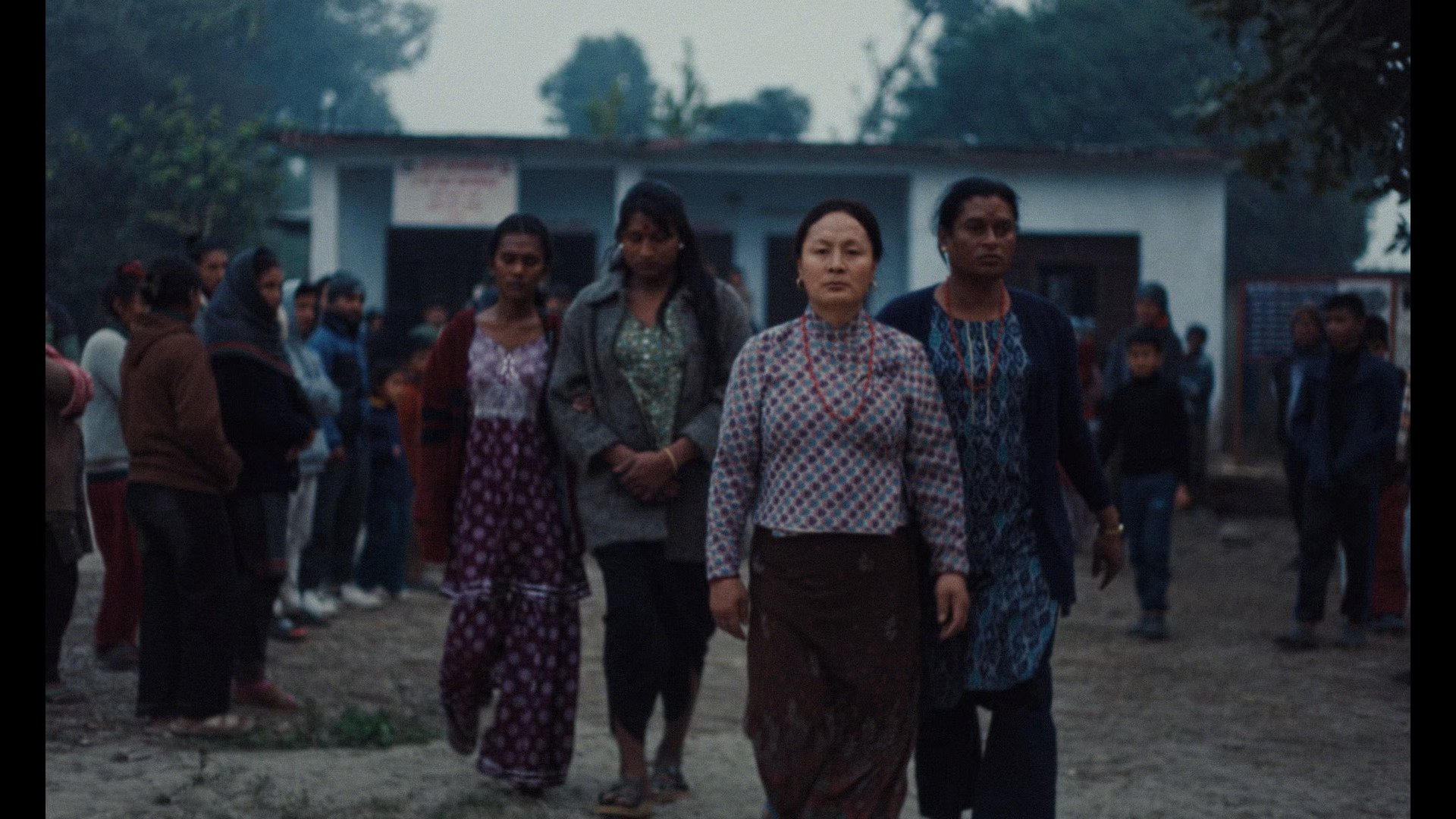
A Kinnar community is thrown into harm’s way when a matriarch’s adopted daughter goes missing in Abinash Bikram Shah’s Elephants in the Fog. The constant threat of harm frames Nepal’s insular village of Thori as a temporary refuge for Nepal’s third-gender community, as they run from persecution in their past lives. What should be a place of safety quickly dissolves when wild elephants loom in the jungle surrounding Thori, threatening their crops and lives as they stampede through dense fog and darker nights. That encroaching atmosphere suffocates every frame of Shah’s fully realized world of humanity trying to keep one another safe—until those actions threaten their own safety.
A searing naturalistic performance from Puspa Thing Lama as Pirati—which literally translates to “love” in Nepalese—shades Shah’s feature debut with verisimilitude and immersion that haunt as much as they draw the audience closer to the film’s Kinnar women. Members of the Kinnar community in Elephants in the Fog take a vow of chastity and pledge to be obedient to their guru, Guru Mate, and care for one another. Within that community is its own hierarchy, rituals and customs that Shah’s screenplay uses to texture an otherwise heartrending drama about survival in the face of rejection. Many of these women have escaped past lives of pain and suffering because of who they are—including one of Pirati’s adopted daughters, Apsara (Aliz Ghimire), whose frequent confrontations with her mother lead to her running away from home.
What begins as a straightforward investigation into Apsara’s disappearance gradually reveals the darkness in the world outside the protections we set up for ourselves. Noé Bach’s cinematography places the viewer within the confines of a rural, isolated village trapped between a prejudiced society and colossal beasts—both of which have the potential to co-exist with the Kinnar community. A muted green-blue colour palette only further accentuates the harrowing stakes and oppressive conditions that make Pirati’s desperate search for Apsara all the more painful to witness. Meanwhile, Pirati faces her own torment as she falls in love with a man outside the village, betraying her vows and placing herself in a position where she may face exile from her own safe haven.
What emerges from the mystery surrounding Apsara’s disappearance is a reminder of the world that the Kinnar community has cut itself off from. However, despite the obvious prejudices that prevent Kinnar women from living “normal” lives within society, there’s a hierarchy in Pirati’s community that breeds its own form of infighting. Women who have already fled trauma or sought liberation through understanding support systems can potentially face further disconnect if they don’t align with Guru Mate’s vision of a community. The catalyst for Apsara’s departure, and the threat of banishment facing Pirati, is their belief that a strong community can exist which allows more freedom. If this is the only place for a Kinnar woman to turn, but it doesn’t align with her vision for a normal life, then where does she have left to go?
Elephants in the Fog doesn’t quite get to those answers, instead choosing to mostly languish within the dangers facing the community. It’s a stark portrait of people seeking acceptance, portrayed convincingly by a cast made up mostly of non-actors. Where the violence is obvious and apparent within rural villages like Thori, Shah makes a point to show how that violence exists but is brushed aside quickly within cities such as the border city of Birgunj, where Pirati’s lover resides. The cost of trying to find oneself is never easy, but for trans women in areas around the world it’s even more difficult when transphobia can find purchase where safety cannot. A haunting, transportive score by Frédéric Alvarez mirrors that clash between tradition and modernity while further immersing audiences in the anguish.
There’s a conversation to be had about how Shah’s screenplay attempts to salvage some humanity within its consistently oppressive tone, from a sympathetic police officer to characters reckoning with their own conflicts. Even with those brief hints of nuance potentially lighting the way for a sense of liberation in Pirati, Elephants in the Fog is more concerned with eliciting empathy from its audience than demonstrating strength in adversity. While Pirati certainly draws strength from her convictions, the takeaway isn't that her journey is justified, but that it could be much easier if people weren’t pushing back against what they perceive as “otherness.” Whatever moral righteousness people claim to be wielding when attacking others and condemning them to a life of poverty and fear, Elephants in the Fog shows that a human life should not be forced to suffer.
The 51st Toronto International Film Festival takes place between September 10th and 20th. Elephants in the Fog celebrates its North American premiere on September 13th as part of TIFF’s Centrepiece program. You can find the full list of films selected for the festival here.
