
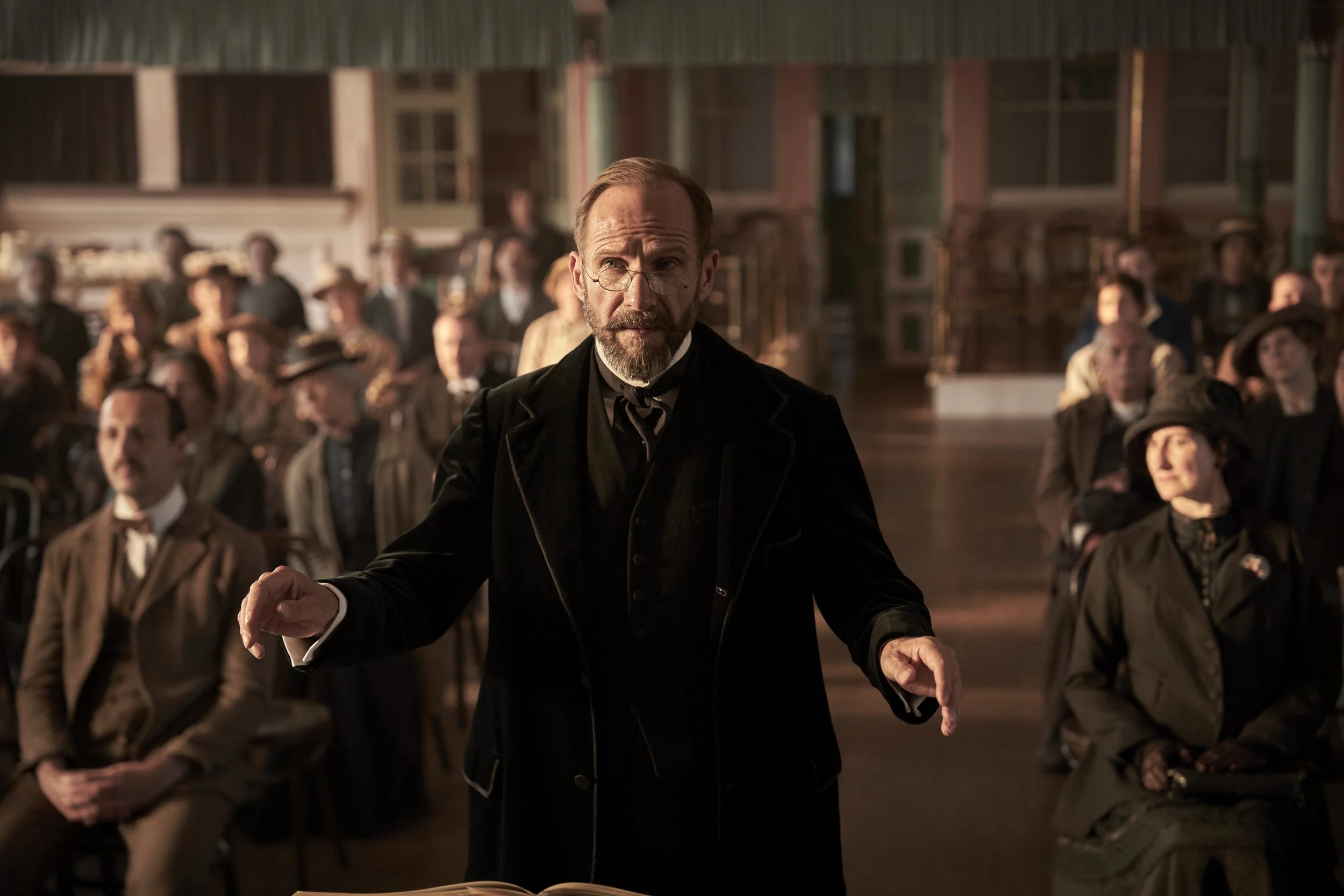
In times of uncertainty, there are few commodities more valuable than normalcy. That notion has more recently been stretched to the point of disconnecting from the real world and carrying on as if nothing is happening outside one’s immediate surroundings, but the determination to maintain the status quo can be therapeutic and lead to beautiful moments of community. This serves as the motivation for the characters in Nicholas Hytner’s latest film, The Choral. A chance to provide a moment of reprieve from the grief and sadness overtaking many during World War I, Hytner’s film illustrates a community’s efforts to stage a music production during dire times, but fails to be more than just an overly sentimental, familiar retread of art being the last refuge from a grim reality.
Small gestures towards something more nuanced and prickly are brushed aside in favour of a far more comforting blanket of a film. The Choral is the kind of movie that assumes its audience is already familiar with its setting, conflicts, and character traits. Alan Bennett’s screenplay is warmly written and goes through the motions of a British WWI-set period film, with no interest in venturing outside its comfort zone. The Ramsden Choral Society finds itself in search of a new choirmaster after their previous one is drafted into the war. In fact, the choir is desperate for men in general, as they’re forced to serve their country once they become old enough to be conscripted. It’s a major problem when the production that Dr. Henry Guthrie (Ralph Fiennes) settles on as the new choirmaster requires men to fill major roles.
Of course, the other problem is that no one likes Dr. Guthrie, and his appointment as choirmaster is a reluctant decision made by the Choral Society in desperate times. A man who went to Germany and became embedded in society for the sake of musical opportunities, his wartime allegiances are frequently questioned and exacerbated by his constant use of German quotes to the quaint residents of Ramsden. His focus on the art makes him seem unapproachable and curmudgeonly, but he emits an undeniable warmth when he sees progress in his work or is struck by a moment of artistic beauty. Fiennes is, as always, a soothing presence whose performance is a bright spot in an otherwise mundane presentation.

The film’s ensemble finds actors like Mark Addy and Roger Allam doing what they do best while the rest of the cast wavers between glum and plucky. There’s not much nuance to any specific character outside of Bella (Emily Fairn), whose lover is presumed dead but still technically deemed missing in action, and the characters that feel like they should be getting more time spent with are shrugged off for the sake of keeping things pleasant. Dr. Guthrie’s homosexuality and atheism are barely touched upon unless it can be preyed upon for emotion, and the film draws attention to a character’s skin colour for all of a few seconds before ignoring her almost completely in the screenplay. These are things that can exist in the background and not be character-defining traits, but the reality is that the town is very clearly conservative and high-strung with emotion from the war that it’s hard to believe these things would simply be accepted in exchange for a performance of music.
Not every film needs to be pointed in its discussions of acceptance, but every conflict the film introduces is almost instantly resolved or pushed aside for a cleaner execution. That’s the kind of film The Choral sets out to be, and you can sense it the moment it begins. It’s a film in which desperation drives characters to do things they wouldn’t normally do, betraying their principles to keep things moving forward. If Bennett’s screenplay had anything truly meaningful to say about this, it would make all of the minor moments matter more. When Alderman Bernard Duxbury (Allam) opines on the lack of ownership he feels should be entitled to him from being the financial backbone of the choir, it’s a minor bout of frustration bubbling to the surface only to be immediately pushed back down. He’s the type of character that audiences know wouldn’t let his money go towards anything less than what he envisions, especially when his own presence in the choir is put into question.
Ultimately, that’s why The Choral struggles to make its final act so resounding: there’s no conflict to make anything feel like a triumph. It is anticlimactic because every fire that ignites is immediately extinguished. Hytner continues to be a director of pleasant films with no edge, which is its own genre at this point and will undoubtedly satisfy the audience that sees the trailer for The Choral and says, “That looks nice.” Because “nice” is about the most complimentary thing you can say about The Choral. Every time it feels like it has something poignant to say, it’s muffled by the inescapable desire to be uncontroversial. Why the film’s staging of a choir production never feels meaningful is that it is tediously dragged through expected narrative beats until the only thing left is a sullen reminder that art has value in the face of tragedy, but it never allows that notion to be truly felt.
