
‘Dead Man’s Wire’ Review
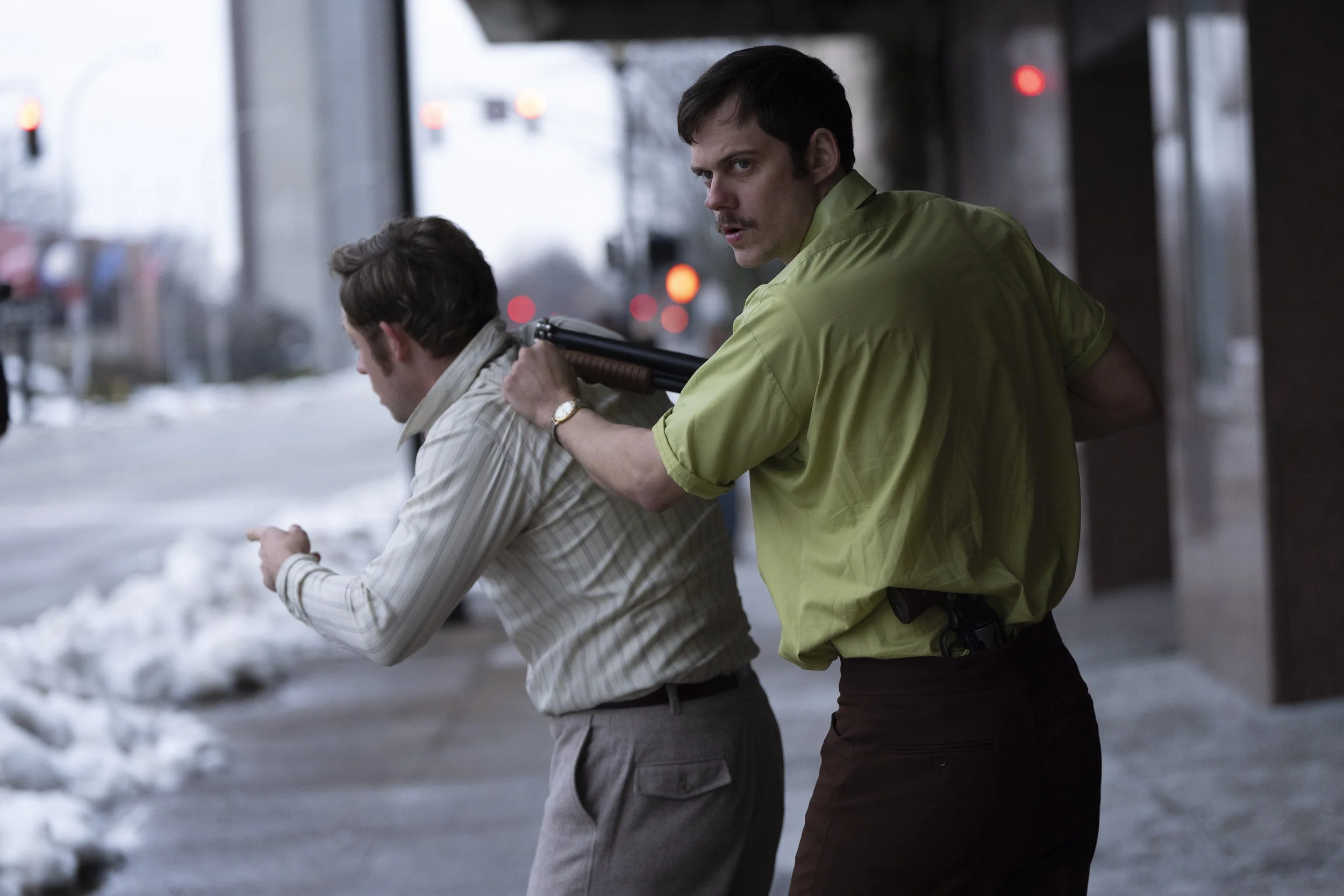
In a story that toes the line between bleak realities of capitalism and absurd crime narrative, the true events that transpire during Gus Van Sant’s latest film, Dead Man’s Wire, are prime material for investigation. The moral bankruptcy of the rich, the cascading of values instilled in us from our youth, and the ease with which people can be turned helpless or desperate in the blink of an eye—these are all ideas that circle around Austin Kolodney’s intriguing screenplay. With Van Sant behind the wheel, Dead Man’s Wire carries itself with an effortless, kinetic energy that makes a movie about two guys communicating on opposite ends of a shotgun far more zany than its subject matter might propose. Van Sant’s direction is an all-consuming force, amplified by a sweaty, invigorating lead performance from Bill Skarsgård that slightly dampens the poignancy of Kolodney’s script in exchange for a thrilling but slight true-crime escapade.
When Tony Kiritsis (Skarsgård) walks into the offices of Meridian Mortgage Company in 1977 with a lengthy box containing a shotgun and a dead man’s wire, he’s not looking to harm anyone in the building except one person: M.L. Hall (Al Pacino). However, Hall just happens to be on vacation when he’s supposed to meet with Tony about a mortgage that is about to ruin his entire life. The circumstances surrounding Tony’s dealings with Meridian are hashed out with the next best thing to the company president: his son, Richard ‘Dick’ Hall (Dacre Montgomery). Hooking him up to a shotgun connected to a dead man’s switch—where any sudden movement could cause the firearm to go off—Tony firmly believes he has the upper hand and appears to when he thrusts his hostage situation into the public eye. He wants a stage: not to become a hero, but to get back what is rightfully his and make an example of M.L. Hall.
It’s an absolutely delirious sequence of events that almost feels too outrageous to believe, but is firmly rooted in the facts of the crime. Witnessing Tony walk through the open streets of Indianapolis—swarmed by police officers, the media, and the public—is exhilarating. The majority of the film takes place in Tony’s apartment, but getting there is where the purest form of tension can be found as Van Sant’s film marries its true-crime narrative with a slick, 1970’s crime thriller aesthetic diegetically soundtracked by Fred Temple (Colman Domingo)—the smooth-talking DJ from one of Tony’s favourite radio stations. It’s a film that moves briskly even when it’s stationary because, like the films it evokes, it has an incendiary quality to its central plight that keeps the audience invested in the outcome. There’s a moral righteousness motivating Tony’s actions that is impossible to ignore with 50 years of distance between kidnapping Hall’s son and seeing the rich continue to get richer off the backs of those simply trying to make a living.
Dead Man’s Wire doesn’t seem too preoccupied with getting at the meat of whether Tony is, in fact, righteous in his crusade, but it’s something Van Sant and Kolodney clearly want the audience to wrestle with after the film’s conclusion. Instead, Kolodney’s screenplay is at its most incisive when it enters Tony’s apartment and forces Richard Hall to become introspective about the ethics of his father’s actions and, ultimately, how much of his father is within him. Upbringing serves as a crucial touchstone in the film, allowing the audience to feel empathy for both characters. That said, it’s difficult to determine whether Van Sant wants audiences to feel empathy for Dick or to hate him, despite his attempts to help us understand the impact his father has had on who he is. Another case of the film sparking a discussion post-credits, but the major struggle is that Van Sant wants something snappy and evocative, while Kolodney’s screenplay seems far more textured.
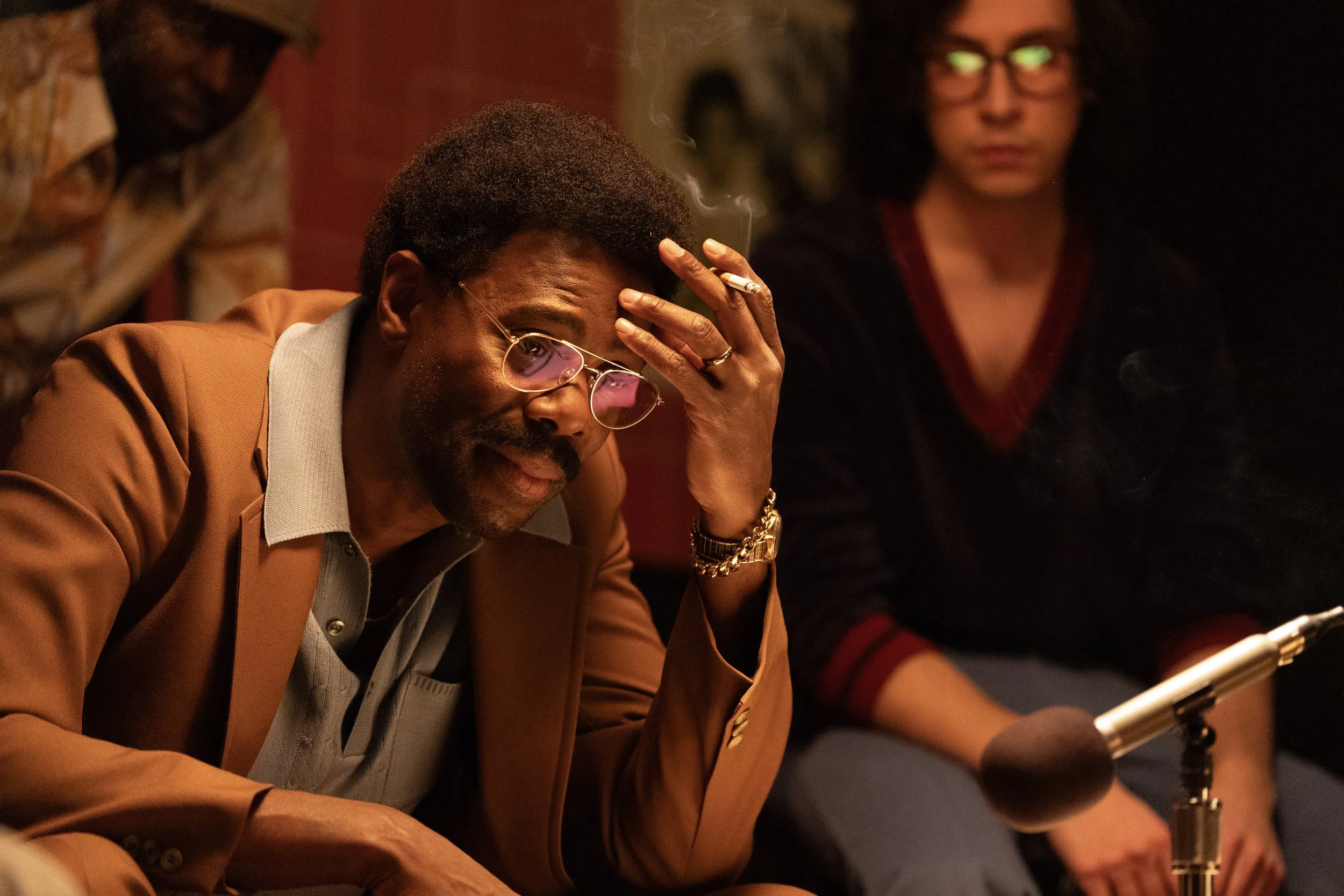
Skarsgård continues to define his career with interesting roles that bear surprising vulnerability. With Dead Man’s Wire, he’s operating on another level with a person whose actions can be perceived as reckless abandonment of control or the complete opposite. Opposite Montgomery’s mild-mannered, fearful demeanour, which occasionally shifts into calculated interrogation tactics, the two have an undeniably fascinating chemistry that makes their one-on-one conversations far more riveting than when Tony is playing to a crowd. Domingo is also exceptionally vibrant in the film as his radio personality placates the erratic gunman, but as the film progresses he appears less like a personality and more humanized in the face of chaos. The only actor who seems to simply be falling into a one-note performance is Cary Elwes, who is surprisingly chameleon-like as detective Michael Grable. He’s got the demeanour of every grizzled police detective in a ‘70s crime film, but he does it exceptionally well, considering Elwes is not particularly known for roles like this.
Presentation can go a long way toward making a film resonate, and Dead Man’s Wire has a very textured feel, thanks to its commitment to capturing the 1970s style both superficially and through its narrative. The radio DJ becomes a voice for the people and the only person who seems to understand Tony; meanwhile, the cops are all laser-focused on catching a bad guy, regardless of whether he may also be a victim. There’s never a question throughout Dead Man’s Wire that Tony might be in the right, but there’s also never a condemnation from the filmmakers—only the characters responsible for Tony’s livelihood. Van Sant’s return to feature filmmaking after a seven-year hiatus is sturdy, reliable work, even when it sometimes feels too riled up to nail down its thematic potency. It’s all there in the text, but Dead Man’s Wire sometimes contains its rage a little too much, so by the end, it feels like the film backs off a little from the intentions made so clear earlier.
