
‘Mortal Kombat II’ Review
If there’s one eternal struggle for adapting video games into films, it’s whether to be completely faithful to the source material or take liberties to translate the interactive medium to a less-immersive format. You are not the hero of this story, nor do you have any involvement in who is the hero. It’s a constant uphill battle, especially in blockbuster entertainment, where the gaming community's desire to see their favourite IP faithfully brought to life on the big screen clashes with the need for movies to engage beyond the established audience.
When Simon McQuoid’s Mortal Kombat released in 2021, Greg Russo and Dave Callaham’s screenplay was critiqued for one glaring omission: there was no tournament. The film attempted to set the stage for something bigger while centring its story around the rivalry between Hanzo Hasashi—a.k.a. Scorpion (played by Hiroyuki Sanada)—and Bi-Han (Joe Taslim), who becomes Sub-Zero. However, that took a backseat to a story of an unlikely hero being summoned for a tournament between Outworld and Earthrealm because of a birthmark that signals him as a chosen warrior. There’s no point in naming who that character is because Mortal Kombat II also doesn’t care about its non-canon characters. Instead, it pivots in the opposite direction to please fans who felt ignored by the previous film’s endless references to a tournament and its thinly veiled justifications for characters' interactions. It’s a gamble that occasionally works but mostly serves as a reminder that video game storytelling is most effective when built around interactivity.
For those concerned, rest easy: Mortal Kombat II has a tournament. In fact, it’s the framework for Jeremy Slater’s screenplay. Outworld has its cast of fighters ready to battle it out for domination over Earthrealm, comprised of those who have become enslaved by Emperor Shao Kahn (an intimidating Martyn Ford) after winning a tournament against the fighters of Edenia. It’s a clever means of slimming down the characters, establishing their role and relationship to one another in the tournament, while also retaining a sense that Outworld is a formidable force that Earthrealm has no hope of defeating in one-on-one combat. It wisely focuses on Princess Kitana (Adeline Rudolph), whose father is killed by Shao Kahn and whose mother, Queen Sindel (Ana Thu Nguyen), becomes Shao Kahn’s consort. Her only true ally is her best friend and bodyguard, Jade (Tati Gabrielle).
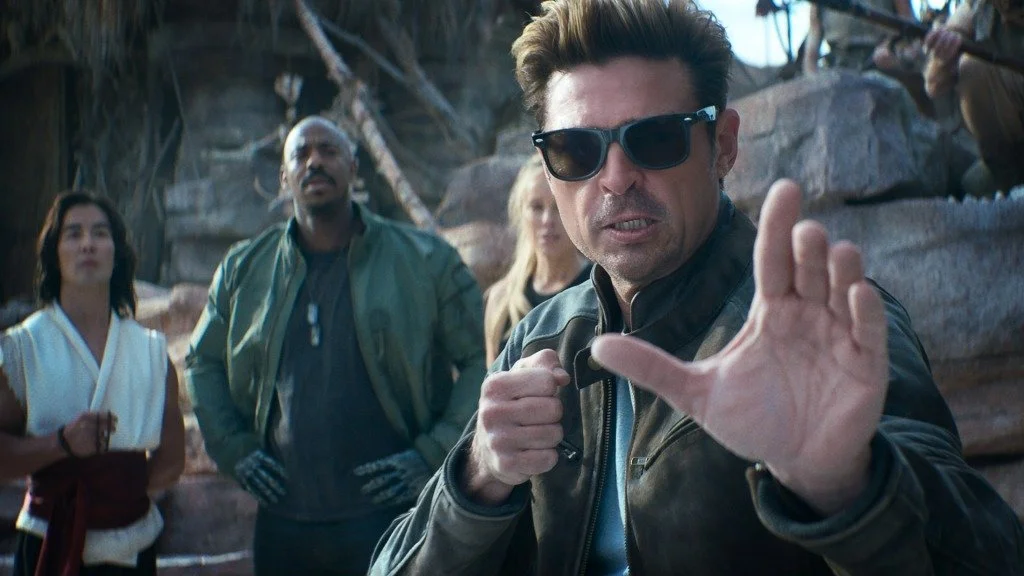
Meanwhile, Earthrealm is desperate for its fifth and final fighter after the events of the first film led to Kung Lao's (Max Huang) death. Hinted at in the closing moments of the 2021 film, Earthrealm’s narrative focuses on that fighter: the washed-up movie star, Johnny Cage (Karl Urban). He’s still making movies, but they’re the kind of direct-to-video paycheques that the former action icon looks down upon. Those unaware will not be surprised to learn that the Johnny Cage from the video games is very close to the one Urban portrays in the film, and is unabashedly an homage to Jean-Claude Van Damme, specifically his character in Bloodsport—right down to the groin punch. Urban mostly works within the role, though his schtick is often undercut by Josh Lawson's more humorous performance as Kano. Alongside Lord Raiden (Tadanobu Asano), the rest of Earthrealm’s fighters return from the first film: Sonya Blade (Jessica McNamee), Jax (Mehcad Brooks), Liu Kang (Ludi Lin), and Cole Young (Lewis Tan).
There are a lot of characters to keep track of, which has always been the case with the video games. The way their stories are ultimately structured is very similar to how Mortal Kombat II frames its fights. Characters will face each other, make a couple of quips beforehand, and then something else might happen outside the tournament that provokes other characters to fight others before returning to the ring to fight some more. Between fights, there is usually a cutscene that sets the stage, moves the plot forward a bit, and lets players choose who they want to fight as in the story, then the consequences play out. Here, it’s the same. As the tournament unfolds, Kitana attempts to escape Shao Kahn's tyranny, Earthrealm sets a plan in motion to ensure their victory, and a reluctant Johnny Cage slowly realizes his destiny.
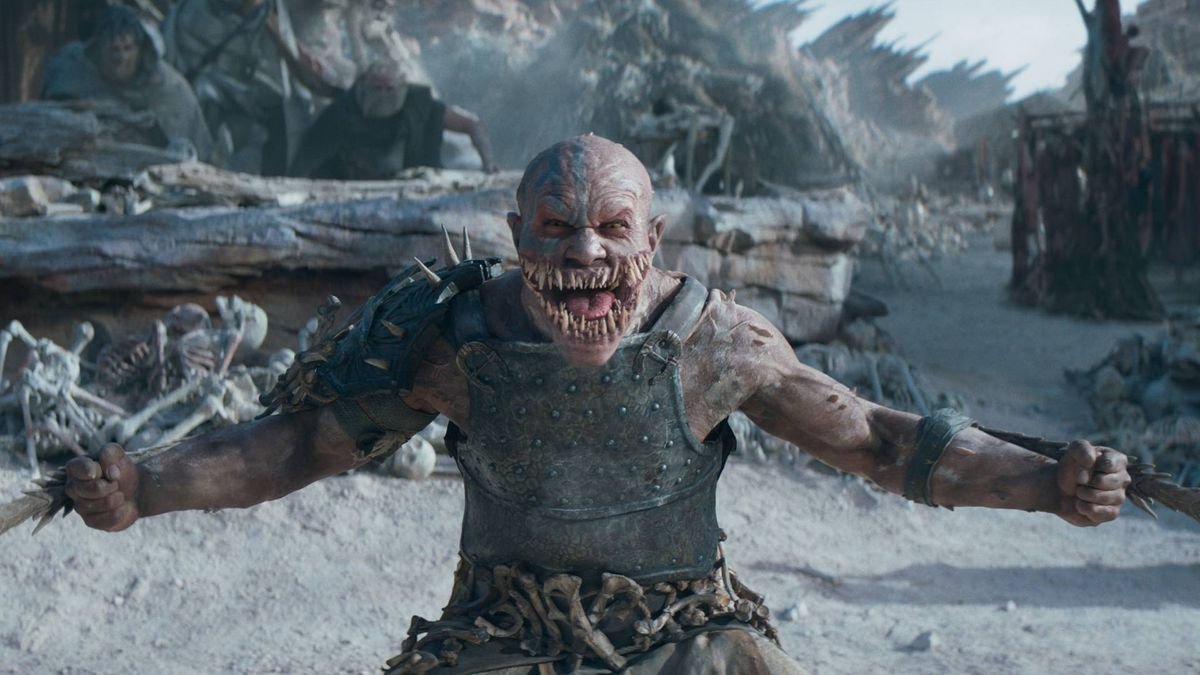
This is the most faithful adaptation of the Mortal Kombat video games yet. It’s chock-full of characters while weaving their separate arcs together in ways that have them confront a myriad of opponents in brutal one-on-one brawls that might result in a Fatality. The realization in 2011’s soft reboot of the video game series, simply titled Mortal Kombat, was that the series has expansive lore and characters with distinct personalities that go beyond their movesets. In other words: prime material for massive world-building with intimate stakes and an ambitious scope. With some exceptions, stories in fighting games felt secondary before developer NetherRealm Studios brought them to the forefront in 2011. Now, it’s disappointing not to see a story mode in the options for a fighting game, as opposed to the expected arcade mode. Mortal Kombat II is largely impressive because it manages to do all of this within the scope of a 116-minute film, as opposed to an eight to ten-hour video game.
For fans of the games, this is great news. However, what becomes glaringly apparent as the film weaves one fight into the next is that there’s no emotion here. The film’s split narrative is constantly complicated by the addition of more characters and sillier contrivances, to the point where, yes, gamers will undoubtedly get a kick out of seeing that person appear like that, but from a storytelling perspective, it deprives the film of any solid foundation to care. Earth’s fate is in the hands of a couple of misfits randomly gifted with powers beyond their comprehension, and not one character from Earthrealm feels important unless they’re told of that importance. Someone is going to see what the film’s magical Arcana unlocks in Cage and ask, “That’s it?”, while those familiar with the source material will cheer unabashedly at their whims being catered to. This is what happens when adaptation must also incorporate current trends of cinematic universes and fan service. The source material is unsurprisingly a great fit for this kind of alchemy.
The area where all audiences will agree that Mortal Kombat II improves upon its predecessor is in the fights themselves. The choreography is much more varied, the fights are edited far better, and the aesthetic feels closer to a comic book and the games than it does some generic Hollywood adaptation. While I think Paul W.S. Anderson’s 1995 Mortal Kombat is an impressive tonal depiction for that early era of the games, McQuoid’s film is a healthy mix of self-serious wizardry and over-the-top violence punctuated by a barrage of quips. Its fantasy trappings are confronted by snarky humans with unbridled strength, and the tone matches that effectively. Fatalities reverberate through a scene because of how nasty they can get, though this is still tame compared to the video games. Outside of the tournament, some of the action is a bit more dodgy, but it all meshes neatly—even if it’s just nonsense on its own.
I am a massive fan of the franchise and its lore, but I have been a mark for most video game movies up to this point and have been left disappointed. Mortal Kombat II is a disappointing movie, but its commitment to simply emulating the modern entries in the video game series provides a solid foundation. Had that led to more experimentation, it might have been a more satisfying film, but McQuoid’s last crack at it featured attempts at that and failed. Instead, this feels like a full-blown fantasy film reminiscent of Anderson’s adaptation, filtered through modern blockbuster sensibilities. Mortal Kombat II will not win over general audiences. It still wastes some of its impressive talent while trying to juggle dozens of characters; struggles to make any of its characters outside of Kitana resonate; and moves too light on its feet to leave any meaningful impression. And yet, it’s an enviable attempt to bring the game to the big screen without compromising the source material, while still working as pure popcorn entertainment.
