
‘28 Years Later: The Bone Temple’ Review
When Danny Boyle and writer Alex Garland teamed up in 2002 for 28 Days Later, they brought an energetic approach to the zombie genre that had seemed absent, reinvigorating the commercial appeal of infected humans roaming the streets. Fast zombies, kinetic camerawork, and a verisimilitude that made its violence harrowing: Boyle and Garland breathed life into a genre that seemed poised to circle the same beats and themes as its predecessors. The inescapable influence of George A. Romero’s Night of the Living Dead franchise remains the cornerstone of the genre, but 28 Days Later offers something fresh to the post-apocalypse, where its infected are a part of the world and not merely a threat.
Which makes sense when looking at what Boyle and Garland came back to in 28 Years Later. The idea of a world in shambles growing and adapting around the “Rage” virus, maintaining hostility against those unfortunate enough to become infected, and segments of the population isolating themselves from the rest of civilization is not a concept that requires much suspension of disbelief in the wake of real-world pandemics and conflicts. Garland’s screenplay was a natural evolution of a society that wants to survive, and it hinted at both sides of the equation trying to keep themselves alive: infected and human. However, Boyle’s film, despite its audacious visual experiments and continued brutality, felt sombre. A more meditative angle left the film aching while also displaying a society forced to come to terms with death. It was bleak but cathartic.
Nia DaCosta’s visual language may be much more subdued than Boyle’s, but the transition offers a much clearer view of what Garland and Boyle have envisioned for this latest trilogy. 28 Years Later: The Bone Temple sheds the chaotic presentation of zombie kills and even decreases the infected body count compared to previous entries, but DaCosta’s latest film wallows in a hostile atmosphere to ask a simple question: Is this all there is? Where Boyle’s latest in the franchise accepted reality, DaCosta shows what a society looks like in that fractured world and offers a glimpse of hope within the chaos. To do so, though, The Bone Temple revels in an unrelenting unpleasantness while juxtaposing itself against people finding purpose within an unstructured hellscape.
Ideologies and belief systems govern the world of 28 Years Later. Picking up immediately after the events of the first film in this new trilogy, Spike (Alfie Williams) is initiated into the cult of Sir Lord Jimmy Crystal (Jack O’Connell), after reluctantly killing a member of the group to become one of Jimmy’s “Fingers”—the equivalent of an apostle. Each “finger” loses their identity, dons a blonde wig and tracksuit, is referred to as “Jimmy”, and instead of “amen,” the group collectively proclaims “How’s that.” It’s the most obvious that the franchise has gone into religion’s role in the post-apocalyptic landscape. Spike continues to act as a moral center, especially in the face of the gang’s gruesome antics, where Spike must either join in or risk becoming a victim of their humiliating violence.
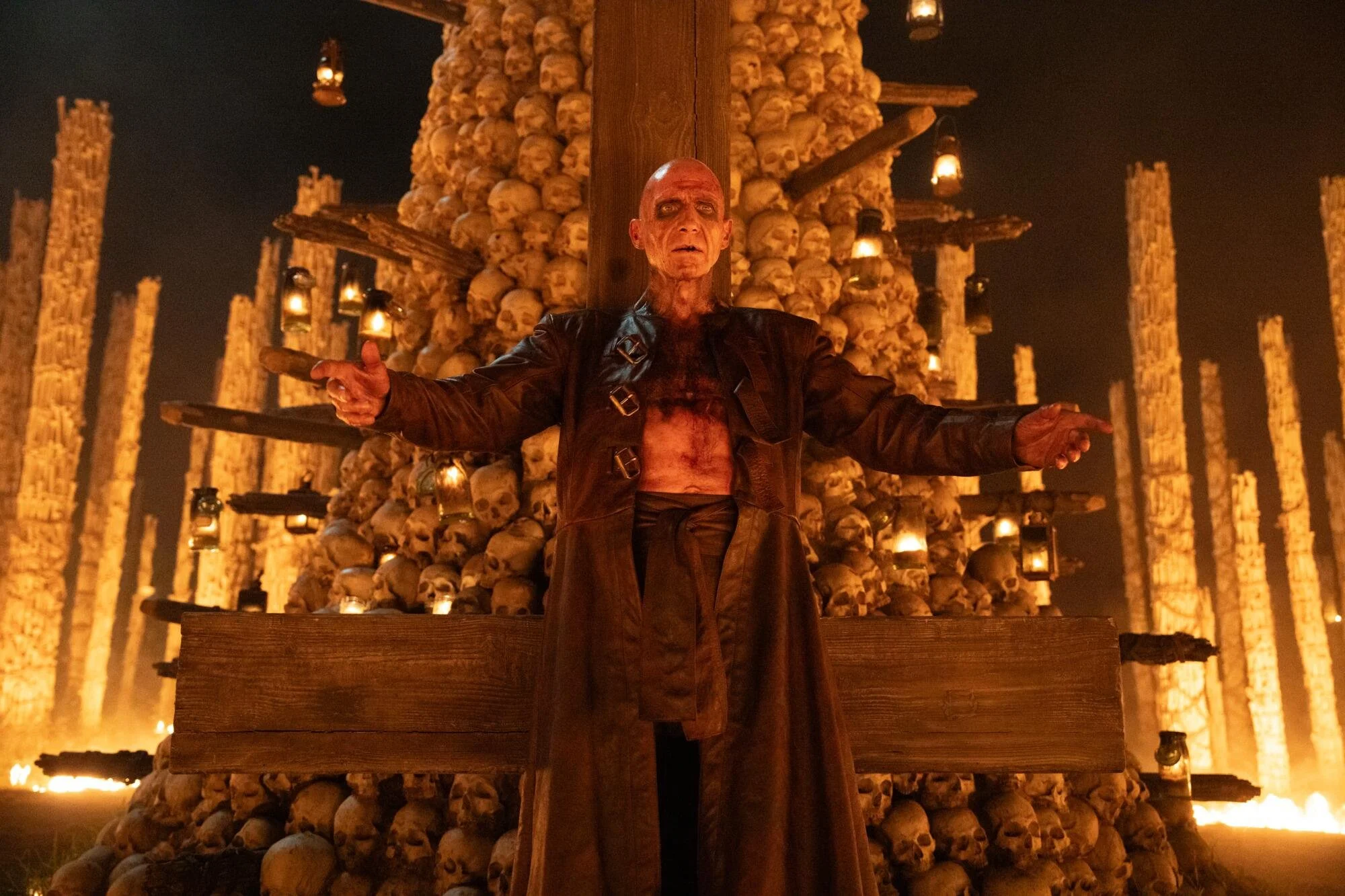
The counterweight to Sir Lord Jimmy Crystal is Dr. Ian Kelson (Ralph Fiennes), who is an atheist attuned to the call of science. He continues to live out his days in his sanctuary surrounded by pillars of bones, but has now gotten closer to the Alpha leader of the infected residing in the nearby woods, Samson (Chi Lewis-Parry). The two form a bond as Kelson slowly realizes that there is still something human in this infected individual, but his approach is a slow, steady attempt at observation that gradually turns into a kinship. Those are the quieter moments in 28 Years Later: The Bone Temple, but they also demonstrate an approach to the infected that is more naturalistic and humanizing than the scientific experiments typically used on them.
While the films remain fairly isolated in scope, it feels as if the entirety of civilization’s reaction to the outbreak can be understood through the dynamic and opposition between Dr. Kelson and Sir Lord Jimmy Crystal. The film’s direct references to atheism and satanism only further an argument of a society fractured into rationalizing the way things are or believing in something else to justify the actions forced to be taken to survive. There’s the idea of trying to make peace with the chaos, and then there’s letting chaos reign, but what DaCosta’s film does that the previous entries haven’t is present the idea that chaos is a kind of middle ground toward some other future. There’s a lesson to be learned here, but are people willing to step outside the walls they’ve built to utilize those teachings?
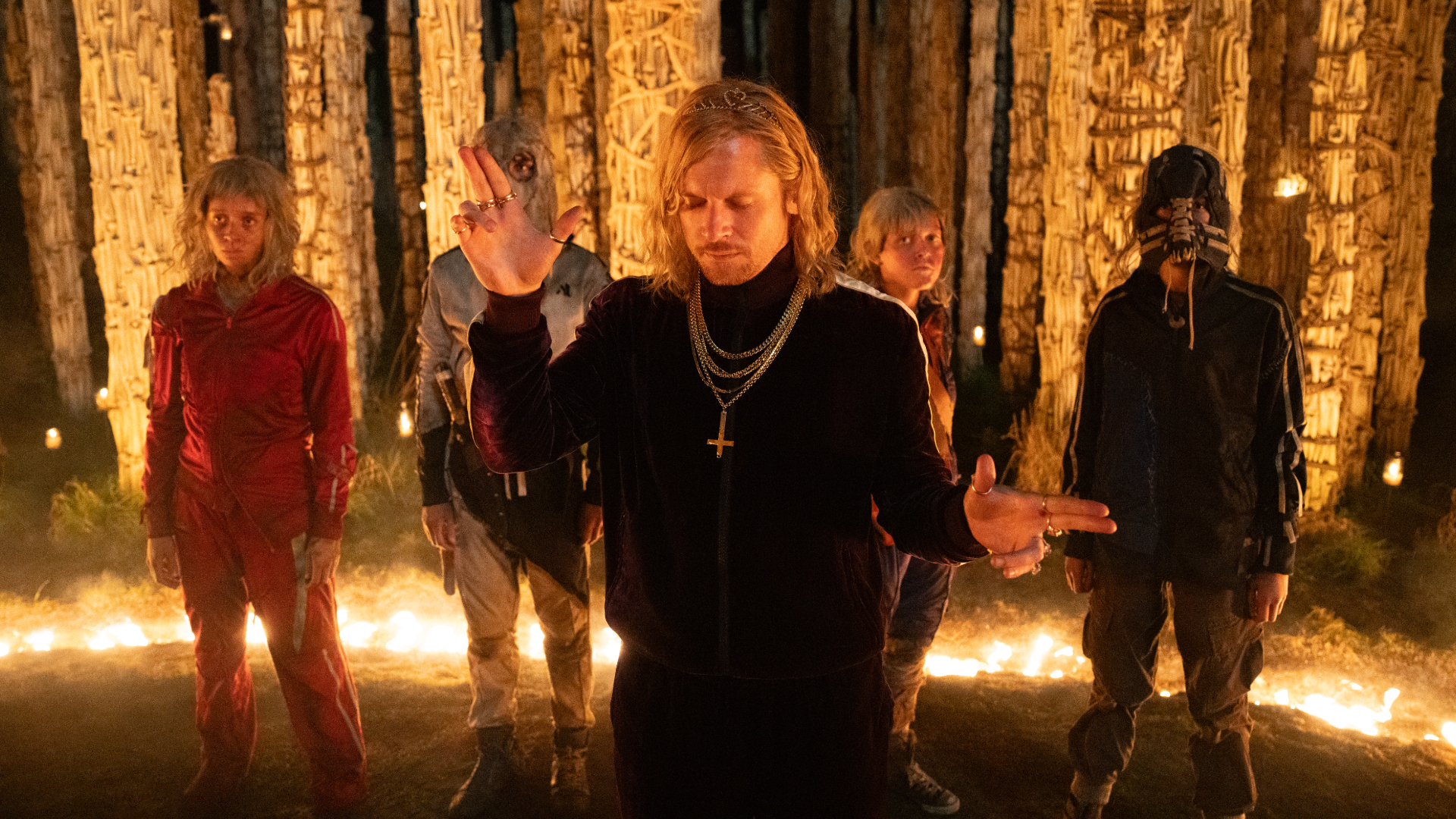
It’s difficult when you’re part of a gang led by a bloodthirsty savage whose word is law and claims to speak for the devil himself. O’Connell’s appearance at the end of 28 Years Later was an engrossing way to end that film, and the way Boyle and Garland hinted at his reign throughout Spike and his parents’ respective journeys outside of their community was smart, economical filmmaking. O’Connell, now being given the keys to the kingdom, imbues Jimmy with an infectious charisma and a severity to his words that makes no question of his intention. When Jimmy’s Fingers don masks before inflicting violence on others, it hearkens to many home invasion thrillers, but what is more chilling is that Sir Lord Jimmy Crystal does not wear a mask—his face is all that should be associated with the brutality of the world. O’Connell’s presence is just as chilling as it was in Ryan Coogler’s Sinners, where he was also threatening to burn the whole world down—the only difference is that here the world has already burned down.
However, the standout of 28 Years Later: The Bone Temple is undeniably Ralph Fiennes for many reasons. The veteran actor was a calming balm to the misery in the previous film, but here he’s acting more as an antithesis to the savage world outside of his sanctuary. The irony of a man who covers himself in iodine and erects pillars of bones from the deceased being the sane person in a sea of insanity is not lost on DaCosta or Garland, which is what makes every attempt to lean into that imagery all the more interesting and how it can be a cathartic expression of loss. Fiennes is given more presence here and a range that shows a man somehow keeping sane by adapting to the world he finds himself in. Not to mention that Fiennes is often the centrepiece of the best scenes in The Bone Temple, including one scene that will make metalheads lose their collective minds. It’s a tour-de-force performance from one of the most dependable actors working today, and it is one of the rare occasions in the franchise where the film manages to contort its grim setting into something more theatrical and performative.
A director’s voice can often get lost in the shuffle between entries in a franchise. It’s even more difficult to avoid when 28 Days Later and 28 Years Later were both directed by Boyle and written by Garland—both of whom were not involved in the writing or directing of the one entry largely being ignored currently, 28 Weeks Later. However, DaCosta’s genre background provides an excellent means of crafting a playground of oddities that blend seamlessly within the world that Garland and Boyle have created. While the film might sacrifice the distinct camerawork and editing of its predecessors, DaCosta is an immensely talented visual director who takes Garland’s screenplay and delivers some of the franchise's most memorable sequences. 28 Years Later: The Bone Temple may be a cruel, nasty film, but underneath the blood and guts is a beautifully layered depiction of a society trying to find its way forward and a fitting chapter in this delirious saga of civilization breaking down.
