
‘Mother Mary’ Review
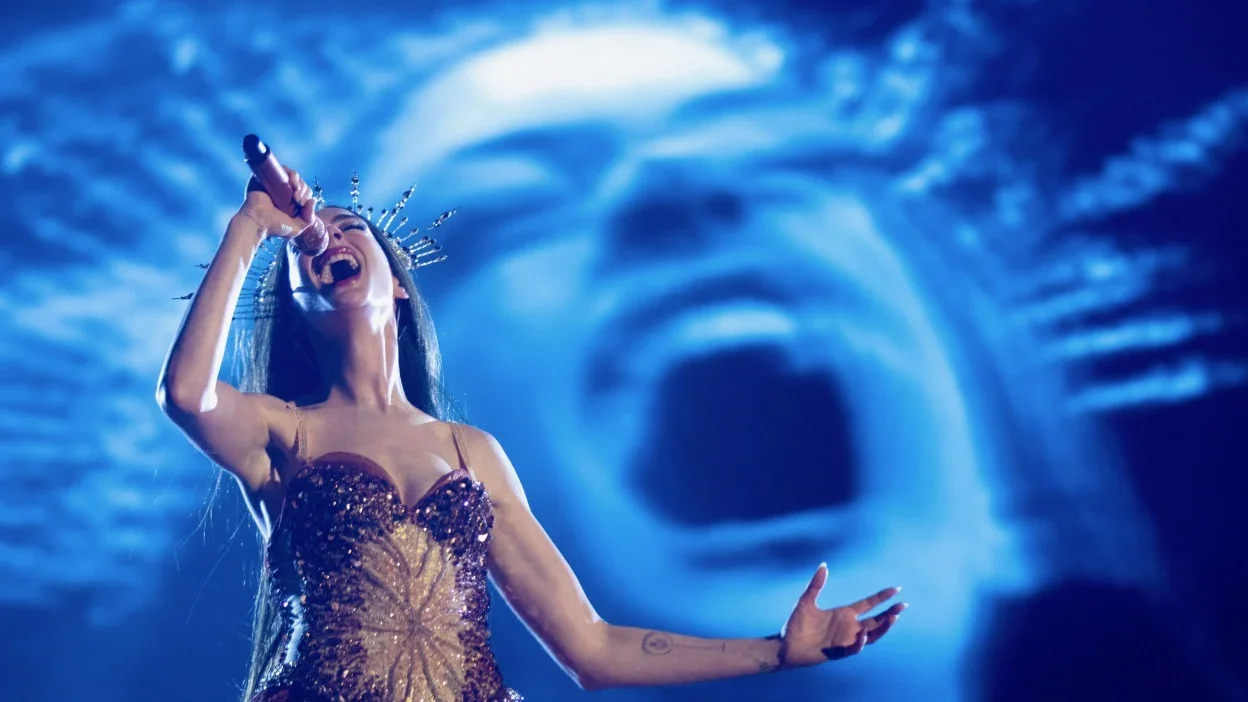
The creative process can yield incredible results, often stemming from an intangible feeling. Something inside of someone is desperate to come out, but finding the tools, the right collaborators, the timing, the environment, and so on, can leave someone crippled with anxiety and fear that they will never be able to reach the finish line and, subsequently, unburden themselves of something haunting them. It’s how David Lowery’s Mother Mary begins: a pop artist finds herself compelled to revisit her past collaborator and create a dress that will complement her latest song. A two-hander lifted sky-high by its lead performances, Lowery’s latest film is akin to his previous atmospheric works in myriad ways, demonstrating his strengths as a visual director and as someone capable of distilling the enigmatic into the thematically potent. However, as Mother Mary drifts further into its supernatural metaphor, it becomes an underwhelming, muted abstraction that loses its characters along the way.
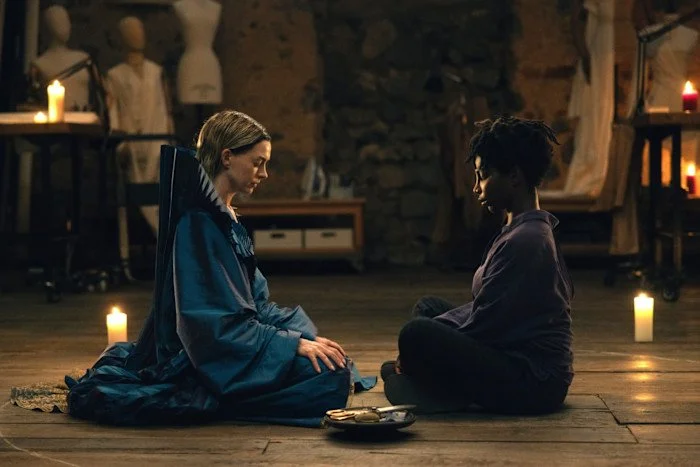
When Mother Mary (Anne Hathaway) bursts through the doors of fashion designer Sam Anselm’s (Michaela Coel) remote estate, drenched in rain and demanding her former friend and collaborator design her a dress, Lowery’s film begins where many great pieces of art are born: from an overwhelming feeling to create. With only a few days until she’s set to perform her newest song and stage a comeback after a traumatic incident, which questions her mental health, Mary’s request can only be achieved by Sam. The trouble is that Sam harbours a resentment so deep that the two must exorcise past demons before they can even approach an understanding of what would be the perfect outfit for Mary’s return to the spotlight. Closed off in Sam’s studio with nothing but a vague idea of what Mary envisions for her masterpiece, the two find themselves navigating old wounds and fragmented recollections that prove integral to the fabric of the dress.
Mother Mary begins as an electrifying tour de force for its stars, Hathaway and Coel, whose characters find themselves combating one another against the backdrop of Mary’s ego and Sam’s resentment. Coel instills a hostility and aggression into every word uttered, but nuances the performance with a deeper sadness that slowly bubbles to the surface. It’s a forceful presence that prods at Mary, who seems to be a shell of herself. Hathaway’s depiction is one of vulnerability and fear, but at times it subsides to reveal the grace and self-importance that have defined her character’s career. She feels like a pop star on the verge of collapse, mirrored in both her demeanour and the physical performance. It’s in the way the camera moves back and forth in a tug-of-war between profiles, or transitions until it settles on one clear leader of the conversation, that reverberates throughout the remainder of the scene.
Much like The Green Knight, Mother Mary is a technically impressive film that might not be as grandiose in scope as the Arthurian adaptation, but it retains a sense of grandeur in its construction, with intimate settings fluidly transitioning into massive rooms decorated to emphasize their respective vastness or decadence. While the film takes place in a single setting, the conversations between Mary and Sam are so immersive that they transform the room—they are ghosts in their own right, whose presence is felt only when acknowledged. Immaculate production design from Sam’s earthy studio to Mary’s extravagant concert performances is not just complemented by Bina Daigeler’s gorgeous costumes or Daniel Hart’s upbeat-but-haunting score—every piece of the puzzle is integral to the other. Separate, they are marvels in their own right, but together they craft a mood that keeps Lowery’s film engaging even as it slowly succumbs to the weight of its metaphoric storytelling.
With past deconstructions of myths, storytelling, history, and memory, Lowery has mastered the art of maneuvering through vagaries and broad concepts to do what Mary requests of Sam’s dress: provide clarity. Characters have often been the weaker point of Lowery’s writing, but here he’s got performances that are visceral, complicated, and inviting that complement some very solid groundwork laid by the screenplay. The mystery surrounding Mary’s disappearance from the spotlight, juxtaposed with Sam’s disappearance from Mary’s life, is enticing enough to explore. However, the metaphor takes precedence over the character work, and Mother Mary eventually loses itself to hammering home a metaphor so obvious and easy to wrap your head around that it becomes painfully dull to watch the film explore it. The emotion is checked at the door once the film shifts into more supernatural territory, and it feels so preoccupied with its abstractions that it muffles its own heartbeat. The characters are felt through performance alone, as the film continues to explore the artistic process and how past traumas are turned into healing anthems.
Moments of sadness and darkness nestle themselves deeply within the DNA of its titular popstar, and that’s obvious in Hathaway’s performance, but the ability for art to heal is most emblematic in the pop songs, which pierce that shroud of pain. With a soundtrack composed of songs written by Jack Antonoff, Charli XCX, and FKA Twigs, sung by Hathaway, Mother Mary’s dark pop melodies pair neatly with Hart’s score while also showcasing how sadness can be turned into something catchy yet resonant. The concert sequences are incredibly staged, aided by Rina Yang’s cinematography and some intricate set design, but they are also storytelling flourishes called upon to accentuate how pain can be transformed. It’s another addition to the veneer of Mother Mary: a film about how, beneath those infectious anthems and pop ballads, lies something painful and haunting.
Lowery’s film finds beauty in heartache, which makes its surprisingly muted emotional arc all the more confusing. The result is something impeccably crafted in almost every regard, but it retains a hollow center that it can’t seem to fill with the same love. Mother Mary simply struggles to get out from under its metaphor. Even with its powerful performances, soaring soundtrack, lavish production and costumes, and engaging mystery, Lowery’s film focuses on an intimate process that requires fully leaning into its characters. Ironically, as Mary’s vague details of what she envisions for her dress gradually come into focus, the characters themselves start seeming more and more abstract until they don’t seem to matter at all.
