
‘Labyrinth’ Review
It’s not difficult to imagine the dystopian world depicted in Shoji Kawamori’s Labyrinth as slightly less of a bummer than it presents itself. A world in which your true self is hidden behind a screen and your doubts and fears cripple your reality to the point of not being able to be yourself anywhere other than online. The ceaseless desire for popularity and adoration from everyone at all times could actually be less of a struggle if there were a way to close the distance between those two disparate halves of yourself. Perhaps the issue is just kids using their phones too much, though. That’s the message that comes across in Kawamori’s hyper-stylized intersection of the physical world and the gray silicone nightmare within a device now perceived as a lifeline. Labyrinth is a fairytale told to the cynical in such a way that it actually makes fair points towards escaping reality in its hollow condemnation of digital technology as the source of all the world’s pain and misery.
When a video of Shiori (voiced by SUZUKA, member of the Jpop group Atarashii Gakko!) falling hard in the middle of a dance routine with her best friend, Kirara (Aoi Ito), goes viral, her jealousy of her friend reaches a fever pitch. A natural-born influencer, Kirara’s carefree attitude has always created a rift between the two high schoolers, but Shiori’s inability to voice her frustration and feelings leads her to text everything she can’t bring herself to say to a separate account only she can access. However, one day, Kirara goes missing. Then, Shiori’s smartphone cracks, inexplicably sucking her into its drab, gray interior and replacing her in the real world with a digital alter ego, Shiori@Revolution. Still armed with a phone in her hand, Shiori must keep her battery alive before she is lost forever and turned into a sticker, much like her unwanted companion, Komori (Taizo Harada), who now follows her every move while trying to help her escape.
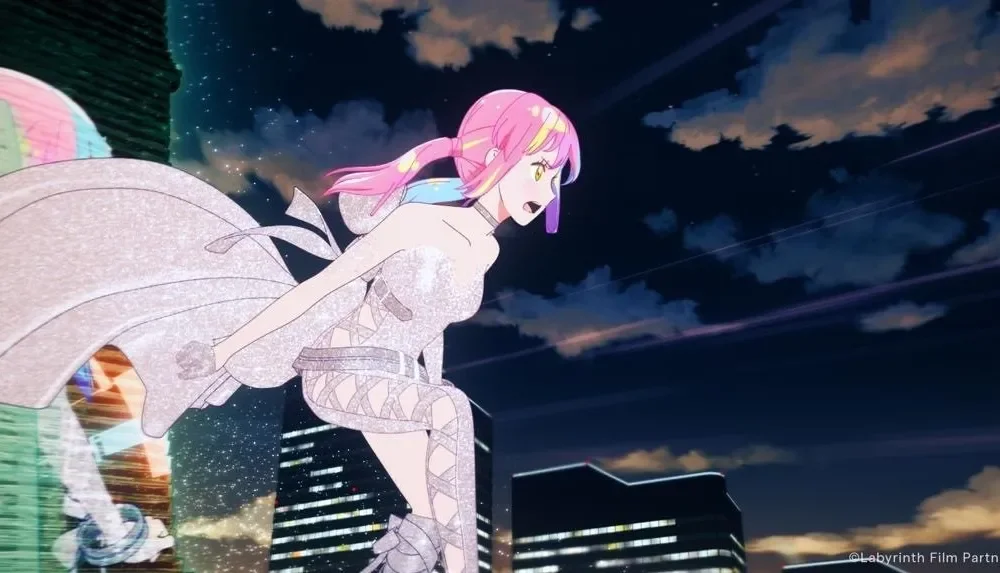
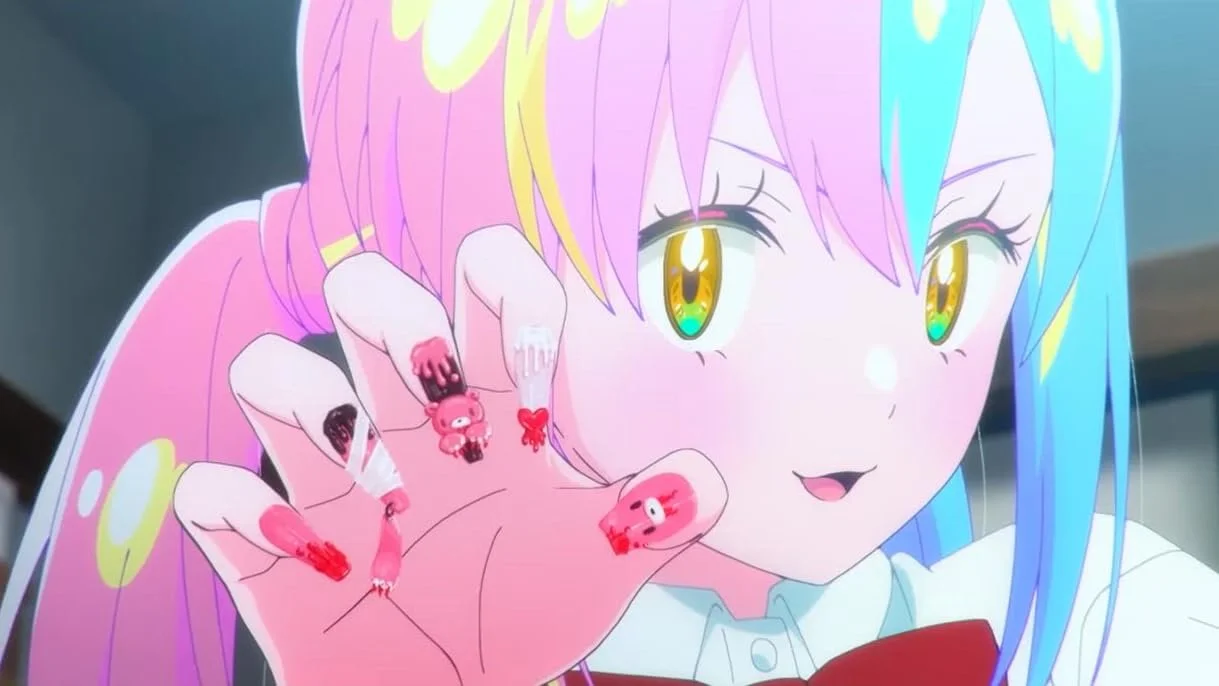
The bright spot of any anime is usually its presentation, and while Labyrinth is not an ugly film, it doesn’t get a lot of chance to shine. The character designs from Risa Ebata (who has worked alongside Kawamori in the past) pop off the screen, especially as Shiori transforms into Shiori@Revolution, and the film depicts the true self as an improved design upon reality. The film primarily takes place within the same locations until the final act, alternating between monochromatic replicas of the real world and the colourful reality it mirrors. Unfortunately, nothing really stands out in the pantheon of digital worlds translated on screen, especially when directors like Mamoru Hosoda have created vibrant virtual worlds in movies like Belle and Summer Wars. Presenting the interior of a smartphone as this drab wasteland is slightly intriguing for the film’s thematic intent, but its post-apocalyptic feeling is wasted on a very scattershot approach to those themes.
Kawamori’s latest anime could be perceived as A Christmas Carol for the TikTok generation, infused with idol music. The pop songs featured have infectious melodies, and the way everyone fawns over the influencer lifestyle only heightens that candy-coated veneer. However, most of the film is a confusing struggle to get to its protagonist’s catharsis, as its central thesis—phones are creating a homogenized community devoid of personality—clashes with the reality that anxiety and self-doubt can’t just be overcome to create this perfect utopia where our digital selves are no longer more tantalizing to inhabit. The film’s comparison of the digital frontier as a “labyrinth” is akin to calling the internet a “series of tubes” in that it shows a simplistic view of something far more expansive and nebulous, while simultaneously using that as a foundation to oppose it. It immediately tells the audience which generation this film is from.
Taichi Hashimoto’s screenplay feels like it’s trying to tee up some homerun for its final act, but spends so much time burying itself that by the time it reaches its admittedly decadent final setpiece, everything rings hollow. The way both worlds physically interact is a fascinating wrinkle that shows how smartphones can be used to communicate with people who seem physically unreachable, but throughout Labyrinth, it never feels like that’s what the film wants to say. It doesn’t recognize what it’s dragging its characters through, and so most of the time, all those physical interactions are just cheap ways of trying to keep the narrative on track. Because otherwise, Shiori might as well pack it in because no one’s really opposing her transformation into Shiori@Revolution. She’s getting popular, attention from others, and while she’s being slightly conned by some college student who got made fun of too much in chatrooms, it doesn’t seem like giving up and reverting back to her real self is better than her digital counterpart.
All of the narrative justification for Labyrinth is pretty flimsy, but at its core, there is something interesting to explore in society’s inability to marry those two separate halves. There is an undeniable split that comes with anonymity, others' judgment, acceptable behaviour, and other societal pressures that keep everything moving forward until the status quo is challenged. However, reality and the internet have the potential to connect and bring out the best in people just as much as they do the worst. Personal condemnations of the film’s misguided themes aside, Labyrinth just isn’t distinct enough to be compelling. It’s a serviceable anime that offers food for thought, but is so obviously narrow-minded that its message will likely fall flat for most audiences.
