
One of the most refreshing science fiction films of the past twenty years would have to be 2014’s Edge of Tomorrow from Doug Liman. The Tom Cruise-starring vehicle was an exciting riff on Groundhog Day, in which audiences watched the action star be killed over and over as he was forced to relive the same day during an alien invasion. Based on Hiroshi Sakurazaka’s Japanese light novel, All You Need is Kill, it also provided Emily Blunt with one of her most iconic roles as Sergeant Rita Vrataski. While that film took liberties with its source material, Westernizing it and making it feel more American-centric, the main beats remain the same as in the novel, with the notable exception of the film’s different ending. However, the film’s changes exemplify exactly why the source material has always felt better suited to an anime or manga adaptation. While the latter came about in 2014 as well, the former is only now coming to fruition.
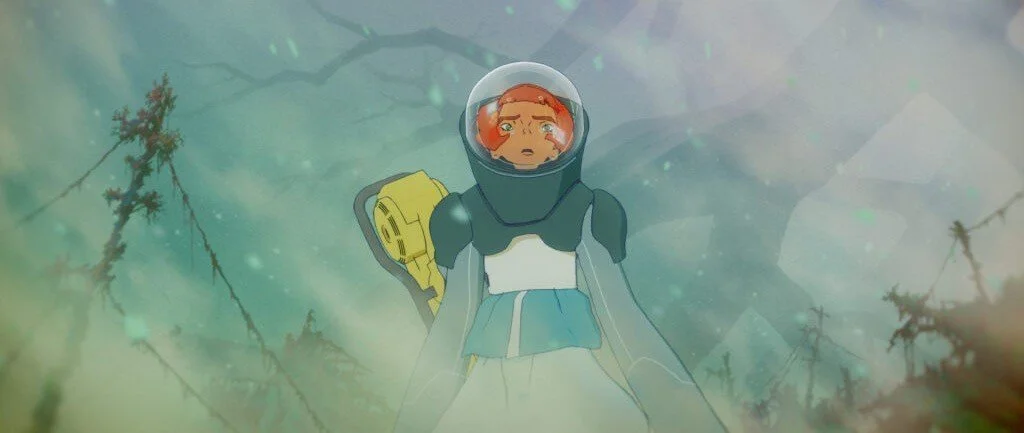
Animated by Studio 4°C and directed by Kenichiro Akimoto, All You Need Is Kill is a striking piece of animation that draws on Akimoto’s impressive past work on projects like Children of the Sea and Berserk: The Golden Age Arc trilogy to create a visually stunning, colourful work of science fiction. Not simply resting on its unique aesthetic that only gets more vibrant and chaotic as it progresses, Akimoto’s feature debut also adjusts its source material to position Rita (voiced by Ai Mikami) in the central role of a woman colunteering to help rebuild Japan who finds herself trapped in a time-loop one year after the Emergence of Darol—an alien structure that has rooted itself in the country and emits electromagnetic waves for no discernible reason. Why it chose Earth to land on remains a mystery a year out, but the larger problem looming is why it has now decided to strike, and why Rita seems to be the only person forced to repeat the same day over and over. It isn’t until she meets Keiji (Natsuki Hanae) that her seemingly Sisyphean task of trying to reach tomorrow feels remotely possible.
At the heart of Yuichiro Kido’s screenplay is this idea of resilience in the face of certain death. Timely, of course, thanks to many issues spelling out doom on the horizon. Rita is contending with her own personal trauma that makes standing at death’s door all the more tempting to simply give up, but All You Need Is Kill fleshes out hopefulness with a dash of romance and purpose, leaving Rita with something to cling to as the number of days trapped in the loop increases. There’s some sappy drama that’s difficult to avoid since it’s so intrinsic to the source material, but Kido’s script finds a rhythm in the repetition until it needs that extra melodrama for a boost.
Such was the case with Edge of Tomorrow, but the analogy to video games remains one of the more apt comparisons to Rita’s struggle. In fact, Keiji’s day begins with him holding a controller in front of a TV as a video game asks if he wants to continue. The notion of building resilience and mastering skills through failure is built into the DNA of many modern video games, especially those by FromSoftware, a company that continues to succeed even as its games, such as Dark Souls and Elden Ring, frustrate players. The trick is to not give up hope, and it’s a fine line that Rita walks every day. It becomes difficult not to turn inward and reflect on past traumas and wonder whether or not it’s worth continuing when it seems difficult to make any progress. By bringing in Keiji to Rita’s plight, the film emphasizes the importance of communication and reaching out for help when needed. After all, everything is dark without any light.
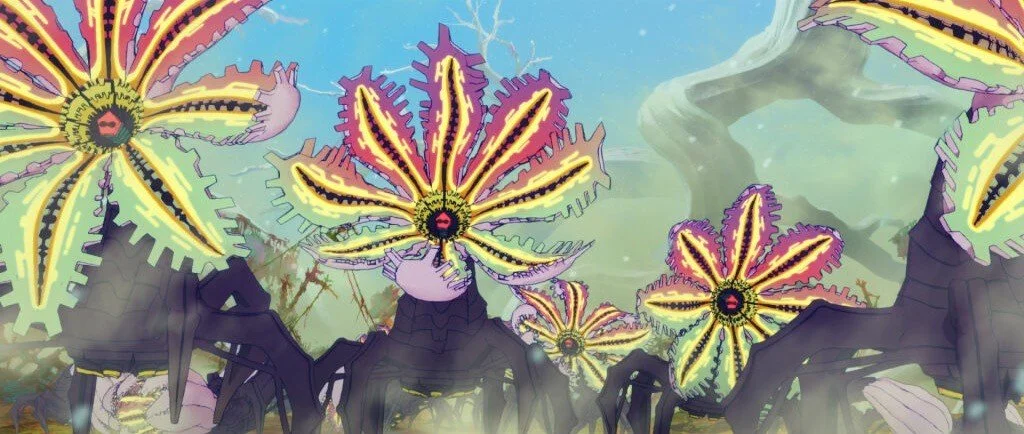
Maintaining that emotional resonance throughout the film’s infinite struggle and incremental progress is paramount to elevating the film’s stylish presentation. Slick brawls between floral monstrosities and bladed robot suits can only sustain excitement so long before there needs to be a heartbeat. Fortunately, All You Need Is Kill juggles both pretty effectively, though most of its more hyperstylized visual flair is mostly reserved for the back end as Rita and Keiji get closer to Darol and their connection strengthens. The character designs are already distinct enough, but as the days spent trapped in the loop pass, the visuals take on a trippier quality that befits an alien flora sending electromagnetic waves through Japan.
Despite having been adapted several times before, Akimoto crafts a fresh presentation of the source material, making All You Need Is Kill a memorable experience. It’s kinetic and brisk enough in its runtime to avoid dwelling too much on comparisons to other adaptations, and Kido’s script tweaks enough to make the perspective refreshing. There are some slight moments of downtime that aren’t as engaging as the rest of the film, but overall it’s a stylish package that captures the essence of Sakurazaka’s novel while bringing its own personality to the table. With plenty of eyecandy for animation aficionados and propulsive action bolstered by a strong thematic presence, All You Need Is Kill carries its heart into battle with a clear eye towards the future of mankind.
