
The captivity of animals for people’s enjoyment and other people’s profits is unsurprisingly riddled with ethical dilemmas. Organizations like PETA have put the spotlight on immoral capitalist behaviour that has subjected plenty of animals to inhumane treatment for the sake of entertainment. When Tim Travers Hawkins’ latest documentary, American Zoo, begins, it feels likely to retread familiar territory: the darkness that lurks behind the closed doors of zoos around the world. The moody score from Dan Deacon synthesizes itself with a nostalgia that hints at the sinister actions keeping zoos profitable as they continually expand their suite of attractions. However, American Zoo unveils a different kind of horror rooted deep in a terrifying history. While trying to reckon with past mistakes and horrible compromises, Hawkins depicts the pursuit of atonement and self-interest as the way in which evil wreaks havoc on society.
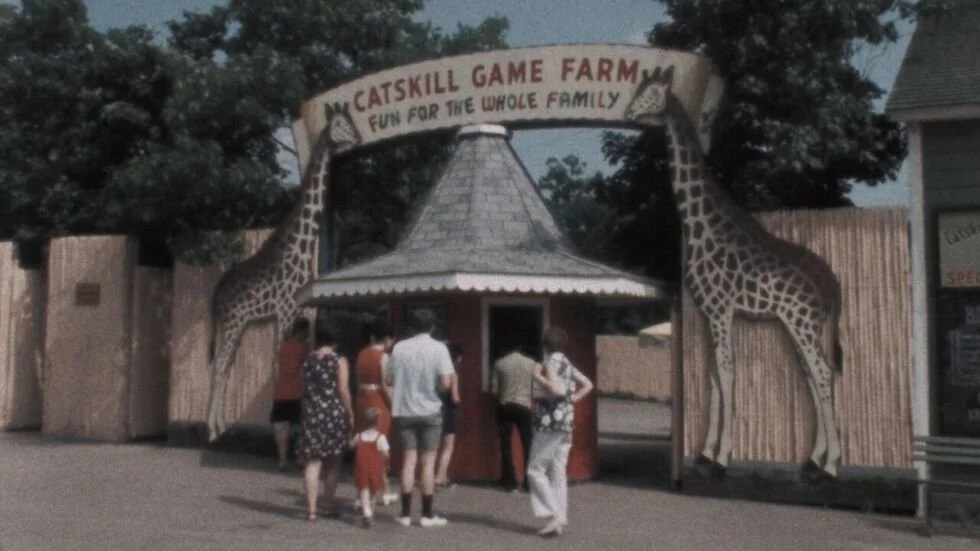
It’s difficult to talk about American Zoo without reckoning with your own preconceptions of whether zoos are humane. As it’s portrayed in the hundreds of home movies and photos unearthed from the ruins of the Catskill Game Farm, there’s a resounding argument against them. However, even that zoo’s founder, Roland Lindemann, claimed there was an educational value to zoos, and nowadays it’s difficult not to find arguments for their role in conservation. The Catskill Game Farm was founded in 1933 by Roland and was subsequently sold to his daughter, Kathie, in 1989, before eventually closing in 2006. Splicing together archival and current interviews with former staff and those affiliated with the institution, against footage recovered from the zoo’s ruins, Hawkins traces the zoo’s history from its inception to the motivations behind its expansion into the country’s largest privately owned zoo.
Home movies of animals being chased and tranquillized in the wild for transport to the zoo, narrated to the audience by Kathie Lindemann Schultz with a tear in her eye and a nostalgia for a bygone era, immediately puts the audience on its toes. The stark images, juxtaposed against a sweet memory, exemplify what American Zoo ultimately homes in on thematically: the pursuit of something beautiful and seemingly unattainable. As it delves deeper into the hiring of German biologist Heinz Heck at Roland's request, that pursuit contorts into something mired in depravity. Catskill Game Farm serves as the foundation for exploring an entirely different angle on zoos, breeding programs, and how Roland’s perception of being “custodians of what God put on Earth” can be stretched to inhumane lengths.
American Zoo depicts atrocities performed in the name of scientific progress; the idea that just because humans have done something wrong doesn’t mean the ends don’t justify the means. The footage Hawkins splices together combines perfectly with interviews to present a condemnation of its subjects’ actions, but Hawkins also tries to see the scientific justifications from those individuals’ perspectives. There’s the historical context that fuels an individual’s belief that what they are doing is right when they are unable to see the other side. Then there’s the perceived good of one’s work that can push people past rational thought. When the film fully delves into its historical atrocities, there’s no question about the film’s stance on the past it uncovers. Still, the approach Hawkins takes navigates prickly material and sensitive subject matter that, with someone else’s direction, might have been realized with less nuance and tact.
American Zoo doesn’t play both sides, but it successfully informs audiences why atrocities occur without any means of asking those responsible. Through its interviews, it shows people wrestling with a heartbreak they can’t quite reconcile with the past they remember. It’s the rose-tinted glasses of those fond memories being ripped from you by an unseen darkness that was always there. The investigative side of American Zoo is where it earns its stripes, spawning multiple questions from footage and research, only to travel across the world in search of answers that are nothing short of despicable. It doesn’t fully explain why things happened the way they did, but it weaves its findings neatly within the notion that no matter how bad something is or how much it might taint a memory, there’s always value in excavating that truth.
The 25th Tribeca Festival takes place between June 3rd and 14th. American Zoo celebrates its World premiere on June 4th, as part of Tribeca’s Documentary Competition program. The full list of films selected for the festival can be found here.
