

There is an intangible beauty to sharing your passion with someone else. Successfully conveying why something matters to you can itself be a challenge, but when that gulf is bridged, it can be the catalyst for something profound. For a lot of people familiar with Anthony Bourdain and his work, his allure was not just in his strong personality or punk-rock attitude that made him revered as a no-nonsense guide through the culinary world; Bourdain’s power was in his ability to distill the essence of something personal and convey a passion for food or culture to any reader or viewer. When that passion came through, it had the potential to ignite a spark in its audience.
Adhering to the essence of what made Bourdain so resonant, Matt Johnson’s Tony doesn’t slavishly run through the chef’s life, ensuring to hit each moment that made him the icon he is today. Just as Bourdain once said that an oyster tasted “like the future,” Johnson, Matthew Miller, Todd Bartels, and Lou Howe’s screenplay depicts a single moment in time that would change Bourdain’s life forever. Pulling from Bourdain’s own bestselling memoir, Kitchen Confidential: Adventures in the Culinary Underbelly, Tony depicts a young Bourdain (Dominic Sessa) as he chases after a girl—Nancy, played by Emilia Jones—to Provincetown, Massachusetts. An aspiring writer, Bourdain is a narcissistic punk kid who has yet to be humbled by the real world until he’s denied a fellowship opportunity, penniless in the streets of an unknown town, and forced to work as a dishwasher in the kitchen of The Flagship to earn his keep while staying on the hammock of its head chef, José Vatel (Antonio Banderas). A brief chapter in Kitchen Confidential, but arguably the one that leaves an impression on its readers as much as the experience did on Bourdain.
Johnson’s film wisely bucks biopic expectations, crafting a coming-of-age story that resonates beyond its real-life origin. By following a formative summer in Bourdain’s life, Tony expends its energy making that moment feel formative rather than telling us it is—a frequent complaint levied against biopics. It’s a textured film where the freedom of summer and youth is guided by financial constraints, mentor-like figures, and the realization that where you think life should take you is not necessarily the right path forward. Michael Bauman’s cinematography captures that feeling of openness collapsing as Tony’s summer is spent with a small community of line cooks and chefs, mostly inside the confines of The Flagship’s meagre kitchen. Claustrophobic handheld camerawork further accentuates a future quickly coming into focus, with the heat of the kitchen only briefly subsided by a gentle summer breeze that reminds us of the beauty lying within that hardship.
A well-researched screenplay that is as much a love letter to Bourdain as it is to the people and experiences that shape us, Tony crackles with the hybrid of punk-rock energy and intellectual stimuli that coloured Bourdain’s career and writing. It moves quickly when Tony finds himself under the wing of one of The Flagship’s rough-and-tumble cooks, Sal (Leo Woodall). The film teases out Bourdain’s future drug problems in life by showing the moment he turns to cocaine—an openly used substance in the kitchen that José dislikes the use of, but understands it keeps people working efficiently. Sal represents the chaotic side of Tony, and their moments together are about as rock-and-roll as they come. It’s not helpful for someone trying to find their way, but it does depict an element of Bourdain’s personality that he would eventually learn to moderate.
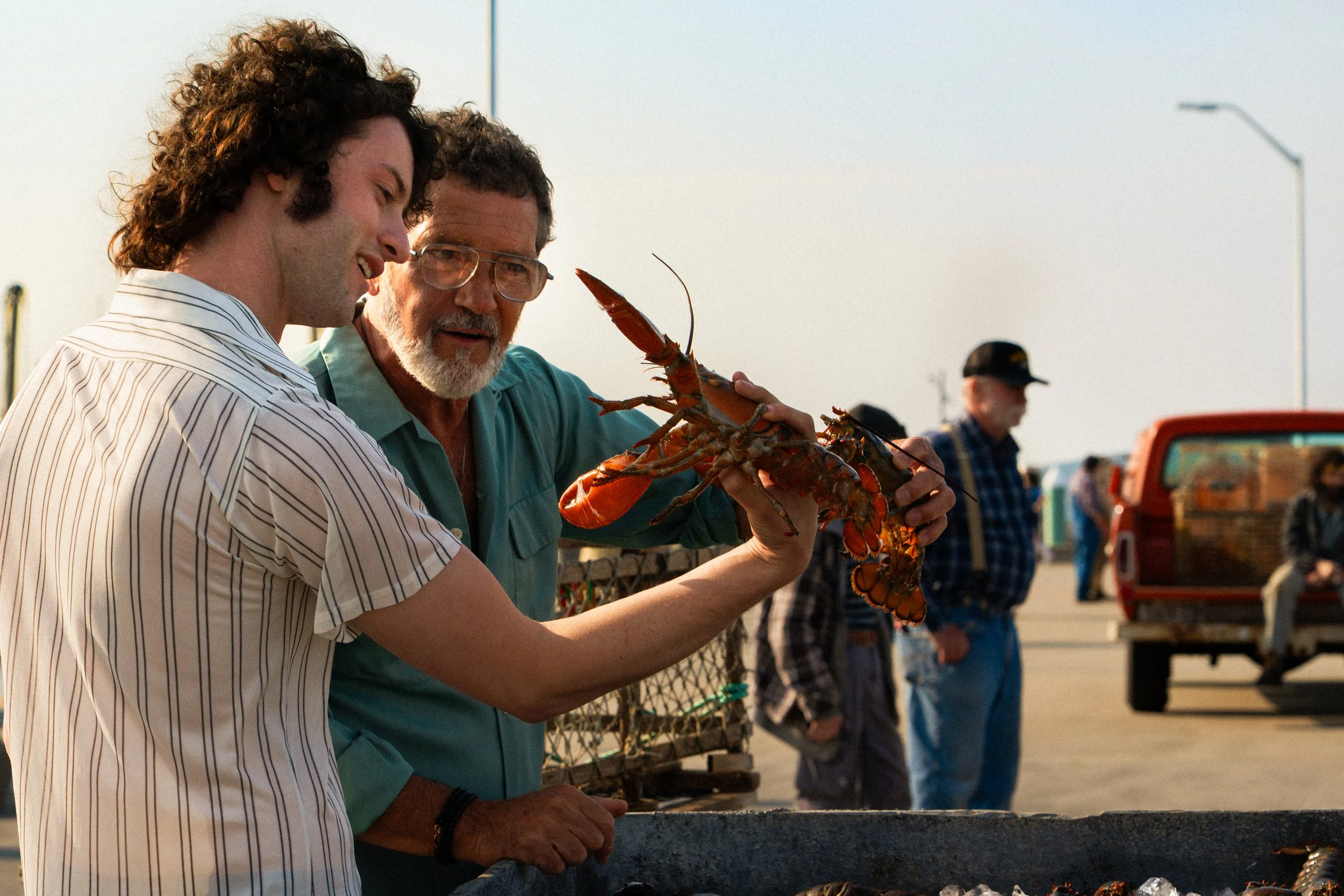
When the film slows down under the tutelage of José, that’s when Tony becomes a delightfully textured film. It’s wholesome in moments shared between a mentor and his apprentice, and more endearing because you can see the gradual realization in Tony’s eyes that he’s come upon something just as profound as Jack Kerouac or Charles Bukowski that the aspiring writer idolizes. The moments when characters share a technique, a drink, or an idea capture a narcissist realizing he has been in his own way. There’s an attention to who Bourdain ultimately became and why he mattered to so many that imbues much of Sessa’s performance and the screenplay’s gentle nudges towards finding one’s path. There’s passion in every facet of Tony that doesn’t celebrate its subject so much as it tries to depict the essence of him. He’s definitely rude and far too blunt, but something warm resonates underneath the rough facade.
Why Tony works as well as it does is thanks to a bevy of incredible performances that feel authentic, lived-in, and understood. The kitchen staff have a bustling-yet-orderly dynamic, all locked into their respective stations to work efficiently, but still maintaining a sense of camaraderie and teamwork that makes the kitchen feel like another home. Woodall delivers an immense performance that feels like the drifter Tony so desperately wants to be, but someone who has drifted far enough into the darkness to scare a young Bourdain. Meanwhile, Stavros Halkias lightens the mood in the kitchen with a familiar, comedic performance that meshes with the team’s dynamic. Banderas’ calm, god-fearing head chef is a delightfully subdued character that the actor has always portrayed with unerring gracefulness. In an environment where everything can fall apart in a second, Banderas depicts a man wanting to share his experienced life with someone who can meet him on his level.
The supporting characters in Bourdain’s life are just as crucial to capture as Bourdain himself, because the screenplay leans so heavily on mentorship, romance, and friendship as guiding lights to adulthood. Outside of work, Tony is chasing a girl in a last-ditch effort to achieve something he set out to do when he left New Jersey for Provincetown. He’s clinging to this relationship, and Sessa’s performance is at its most indelible outside of work. It’s where he’s confronted with reality in all its blistering chaos. Gone is the structure that the kitchen has brought him, and as much as he fights the gradual order being brought to his life, the quiet moments speak volumes about how much the chaos scares him. Jones could have been utterly wasted in a role like this, but thanks to Johnson’s direction, her performance is similar to an audience surrogate. Both her character and the audience are trying to figure out whether Tony is bad news or whether his intelligent, vulnerable side will win out.
Tony does not fully rid itself of biopic pitfalls, but those tropes carry the film forward in natural ways. Set entirely over one summer, based on a single chapter in a book, and confined to one setting with no real drama to crib from, the screenplay’s breeziness does not undercut how much weight that single summer held for Bourdain. The film shares in the understanding that particular moments in time shape us as individuals. In the case of Bourdain, it’s a wake-up call. Johnson’s coming-of-age film might not depict the entirety of the icon’s legacy, but Tony better represents its subject by putting all its effort into portraying the essence of Bourdain.
