
TIFF 2026: ‘Ladies and Gentlemen, Brian Mulroney’ & ‘Anchors Aweigh’
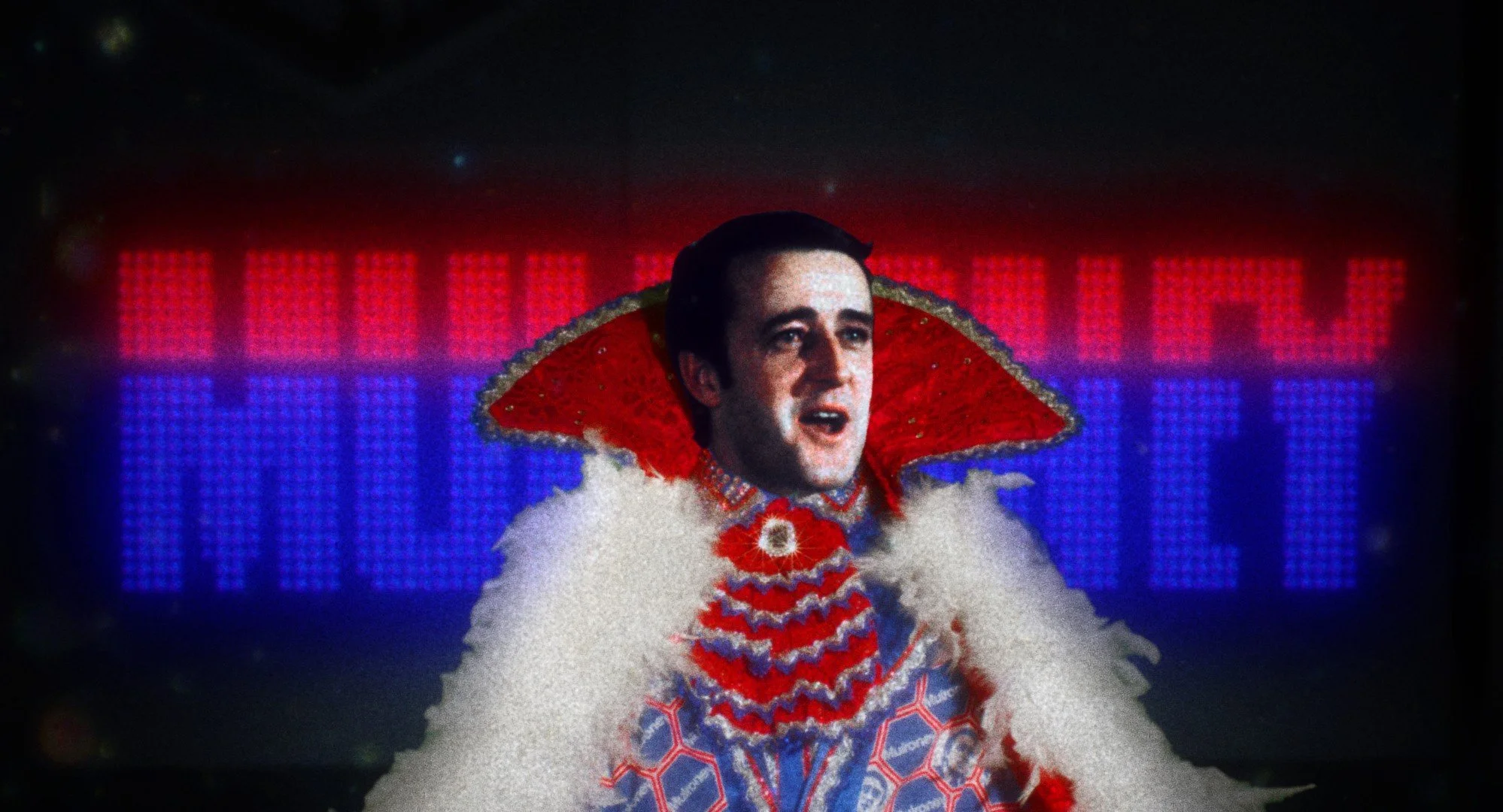
From this point onward, all documentaries about former Canadian politicians must be directed by Matthew Rankin. Even at its most tame, Rankin’s latest film, Ladies and Gentlemen, Brian Mulroney, conveys relevance to today’s political landscape worldwide, so the Winnipeg-born director didn’t have to add any flourishes to the film. Rankin turns a major shift in Canadian political history into a hypnotic, charming psychedelic vaporwave experiment. While it features plenty of referential humour for those who grew up on a healthy dose of Canadian programming, Ladies and Gentlemen, Brian Mulroney is at its most resonant when its fever-dream visuals are dwarfed by ideologies transformed for popular appeal.
Rankin’s collage of Canadiana begins at the 1976 Progressive Conservative leadership convention and then tracks the shifting landscape of a political party desperate to oust Liberal leader and 15th prime minister Pierre Trudeau from power. As Ladies and Gentlemen, Brian Mulroney introduces its cast of characters, from John Diefenbaker to Joe Clark to Mulroney himself; it also explores the ideologies and popular sentiment around each politician wrestling with a constant inability to beat Trudeau. 35 years of Liberal government since Diefenbaker lost to Lester B. Pearson, the Progressive Conservative Party was at a loss and would take anything for a win.
That desperation hints at how Rankin’s film portrays both Mulroney and the Progressive Conservative Party, which eventually elects him as leader after some missteps along the way. Ladies and Gentlemen, Brian Mulroney is less concerned with Mulroney’s time in leadership than with what allows someone perceived as unfit for the job to eventually take control (and hold it for multiple terms). Broken into an episodic format that remixes Canadian history with Canadian pop culture, Rankin illustrates a rise to power in digestible chunks, filtered through entrancing visuals. It’s not the kind of film you can recommend without some context. Rankin’s filmography, especially his short films and The Twentieth Century, helps set aesthetic expectations for his latest documentary and might draw international audiences in with the execution rather than the subject matter. Why Ladies and Gentlemen, Brian Mulroney is brilliant is that the historical ideas it confronts can be seen in the current political climate, but it conveys them in a way that entertains audiences while teaching valuable history lessons.
The 51st Toronto International Film Festival takes place between September 10th and 20th. Ladies and Gentlemen, Brian Mulroney celebrated its World premiere on September 15th as part of TIFF’s Midnight Madness program. You can find the full list of films selected for the festival here.

The trail being blazed for alt comedians into the film world has been the gift that keeps on giving for those of us attuned to the John Wilson, Joe Pera, Nathan Fielder, Conner O’Malley, and Tim Robinson brands of humour. They all tend to work within a general anxiety that befits the current social climate while poking fun at the pervasive sadness rippling through day-to-day life. That’s what made Matt Barats’ Cash Cow an impressively enriching commentary on pinning hopes on capitalist pursuits and the gradual erosion of self-worth that often follows. Anchors Aweigh is a different kind of sadness, steeped in self-reflexivity as a lonely man struggles to accept reality.
Mileage with Barats’ latest film will depend heavily on accepting his particular comedic style. It’s a brand of comedy that leans more toward aggressive self-deprecation while still retaining the calm of fellow comedian Joe Pera. Anchors Aweigh follows a man who proposes to his girlfriend (Serena Profaci), only to be told “no,” and then begins to look inward to figure out what went wrong. However, as he explores years of home videos he recorded himself in his teenage and young adult years, it becomes clear that his romanticism may have been thwarted by never really growing up. Or maybe he should have proposed on one knee like he’s seen in the movies.
Anchors Aweigh has a deceptive simplicity that Barats’ repetitive navigation of his past self accentuates, which feels less like echoes of who he used to be and more like a sustained note of anxiety he never accepts. This leads to constant self-reappraisals that trap him in cycles of devaluing his self-worth. The sheer amount of home videos kept that seem to simply be an archive of boredom makes for a sadder companion piece to John Wilson’s seemingly innocuous footage because Barats’ character never finds the thread that makes the footage fascinating, while Wilson colours the mundane with optimism and potential. Barats’ character simply films it all but can never see the endpoint.
It’s not the type of comedy that will work for everyone, and some of the jokes are definitely so drained by Barats’ weird blend of hopeful-yet-apathetic delivery that they don’t quite land all the time. However, Barats, as a filmmaker, sees what his character doesn’t. Every small detail and action is immediately rewarding and gradually reveals more as his “series of vignettes” becomes evidence of how easily we slip into rhythms and accept realities without committing to actions long enough to realize our aspirations. It’s slightly profound, much like its influences and contemporaries, with its profundity lying in the understanding that resonance can sometimes just be a mirror.
The 51st Toronto International Film Festival takes place between September 10th and 20th. Anchors Aweigh celebrated its World premiere on September 16th as part of TIFF’s Midnight Madness program. You can find the full list of films selected for the festival here.
