
‘Minions & Monsters’ Review
Plunging into the heart of cinema, Minions & Monsters is not the first place one would look for a reverence of cinema’s past achievements. While Illumination has turned the adorable little yellow henchmen from the Despicable Me movies into their own successful franchise of Charlie Chaplin and Jacques Tati-inspired hijinks—with a healthy dash of morbid comedy—the films have always felt slight and meandering. Adventures beholden to a timeline involving their leader, Gru from the Despicable Me films, have had the potential to go weird, but rub against the insistence that the series is nothing without Gru. On the contrary, Despicable Me is nothing without the Minions. Finally, the series expands its scope, placing reverence for movie history at the forefront of an otherwise familiar Minion adventure powered by pure passion and creativity.
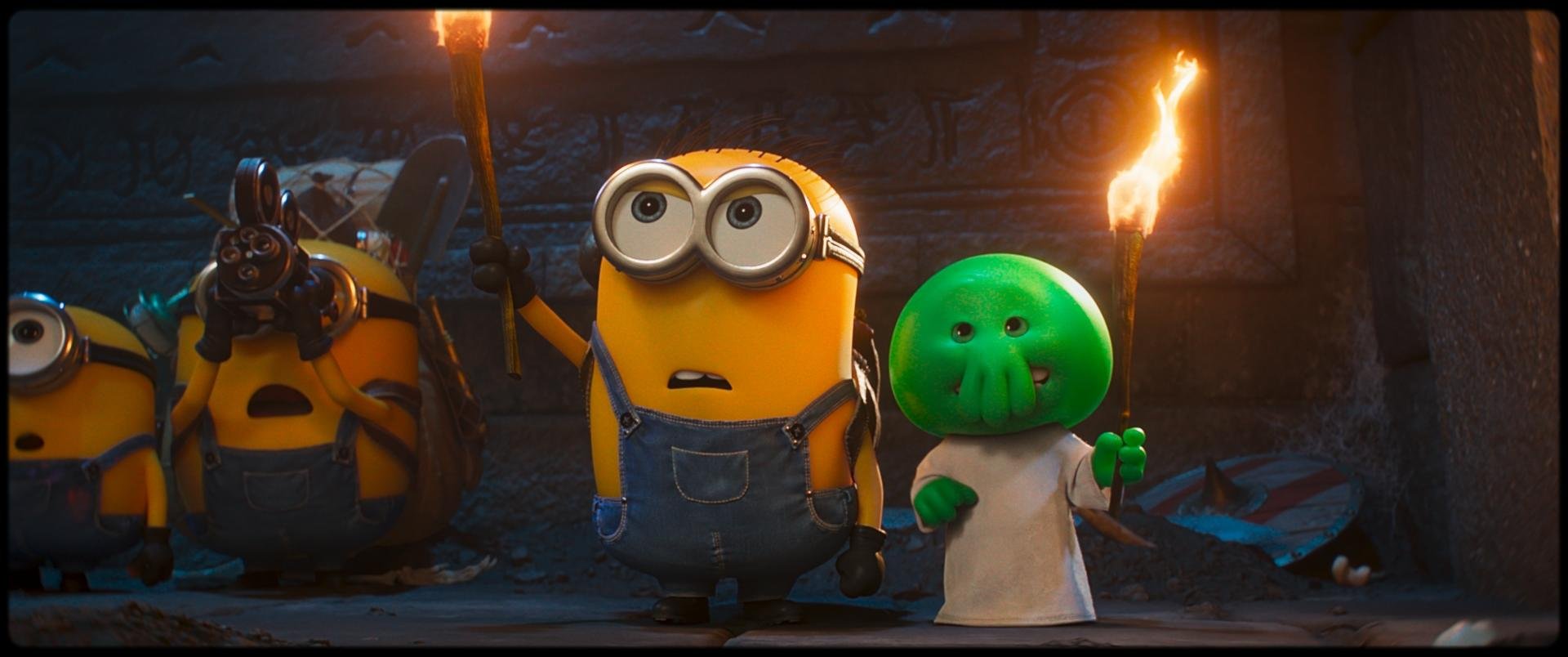
Gone are Stuart, Bob, and Kevin from the other Minions movies, as Minions & Monsters traces a different tribe’s journey from ancient times to their discovery of Hollywood in the 1920s. Still desperately seeking a villain worthy of their unyielding devotion, they soon find themselves the subjects of adoration from film executives Frank and Elwood Bright (both voiced by Jeff Bridges) and the muse for director Max (Christoph Waltz). While most of the minions simply follow orders, James has found an outlet for his creative imagination and sees an opportunity to make a film with the help of his best friends, Henry and Ed. As they begin a last-ditch effort to make a monster movie with the help of a spellbook acquired along the way, the trio separates from the tribe while the others try to find a new villain to follow.
Minions & Monsters never feels monumental, but it always feels special. The story of James, Henry, and Ed’s trials to create an Oscar-worthy film is framed with slightly obtrusive narration from Allison Janney as a Hollywood studio tour guide, but it’s also positioned as a story of significance—an untold story of those who fall in love with the movies and desire to give that love back to others. With a statue of James and Henry sandwiched between Orson Welles and Alfred Hitchcock during the studio tour—as important figures in cinematic history—Pierre Coffin’s film is playful in its revisionist history and has the same silly approach to respecting cinema’s forefathers as the video game company Ubisoft did with their Mario + Rabbids crossover game, which let the company be considerate with a franchise while letting their own little mascots run amok with video game pioneers.
There’s an educational factor to the way Minions & Monsters employs its movie references. When the Minions first discover Hollywood, it’s through a cleverly constructed sequence that sees them barreling through cinematic history with about as much care as they’re wont to have. There’s magic to it, though, if you bother to dig into those references after the fact or come to it ready to point at the screen with the same encyclopedic knowledge of cinema as comic book fans have been doing for the past couple of decades. That the Minions are celebrating movies rather than their own universe is far more tasteful than the cinematic universes that came before. Specifically, it’s the way the film demonstrates how passion can be turned into contribution that makes it substantial, rather than merely referential.
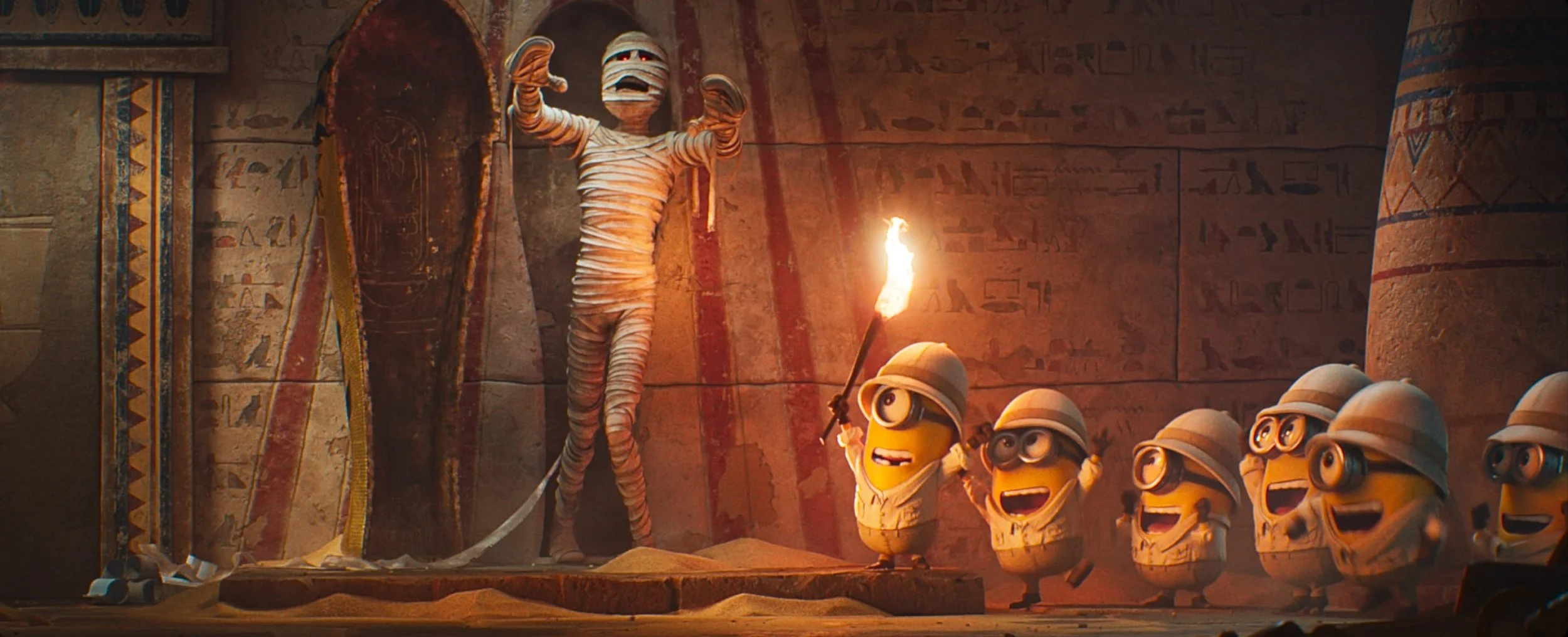
Unfortunately, there is still a bit of tedium in James, Henry, and Ed’s journey, especially once the film's plot takes over. They summon a Cthulu-like figure, voiced by Trey Parker, that appears adorable but may have an ulterior motive to helping the trio make their movie. More monsters start piling up, and none of it ever feels significant. The film’s inciting incident that drives the Minions from fame to desperation is a hilarious nod to the sad reality of many films’ past stars, as the transition from silent movies to sound demands more serious films that the Minions simply can’t conform to. It’s a touching tribute that works well with the Minions, but once its point is made, the film eventually devolves into the usual Minion arc: find bad guy, follow him around, then inadvertently save the world.
There’s an entire separate storyline involving a robot overlord named Dort (Jesse Eisenberg) that is an obvious reference to The Day the Earth Stood Still, but because the Minions involved in that storyline are just looking for an evil guy to follow, it’s all superfluous and seems to just exist to keep the Minions busy while James, Henry, and Ed try to put a film together. There are some funny moments, but even from an animation standpoint, it’s all familiar territory for Illumination’s mascots. Your mileage will vary on those beats, but the joke ratio is a little better here than in previous outings. While the climax shares some DNA with 2015’s Minions, it’s a little more visually varied, making for a more entertaining ride.
As a fan of both the Minions and movies, Minions & Monsters pressed all the right buttons for a while. It’s not a groundbreaking feat of filmmaking, but its playfulness with the medium's history is far more reverential than I could have imagined from a series that has always felt slightly inconsequential. It’s still mainly geared towards children and families, but it’s one of the few animated films whose references are intended to be educational rather than self-gratifying. To see the Minions move from a Harold Lloyd set piece to a Buster Keaton one mere seconds apart is satisfying for cinephiles, but also opens the door for young movie fans to dig deeper into their passion. That the filmmaking process is also teased out in front of them makes Minions & Monsters a high watermark for the series, and one that might serve as the catalyst for a younger generation to pick up a camera and make films with their friends.
