
A medium going to an abandoned hotel to investigate a paranormal presence is a solid foundation for any ghost story. It’s not original, but the hook is creepy and, if handled well, can be a bountiful source for frights. Never After Dark builds from the sturdy backbone of a haunted house in the Japanese countryside, playfully investigating a spectre that won’t completely leave this Earthly realm before revealing a much more satisfying, twisty, and unnerving final act. Dave Boyle is treading familiar territory with his latest feature, Never After Dark, but does so with an invigorating energy reminiscent of James Wan’s horror oeuvre. Slick production values and a fun lead performance elevate unsettling imagery and classic horror scares that won’t leave much of an impression afterwards, but make for a thrilling ride throughout.
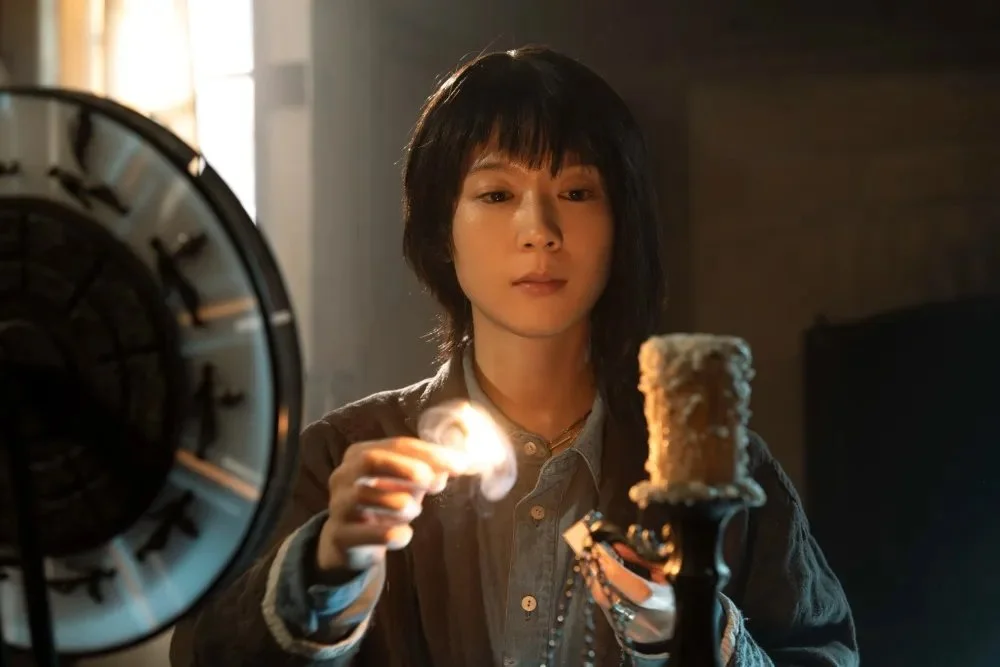
By the time Airi (Moeka Hoshi) pulls into the driveway of her latest client’s home, we already know she’s wrestling with her own past. Her sister, Oita (Kurumi Inagaki), haunts her as she moves from job to job as a medium specializing in exorcism. Her latest clients are an excited mother, Teiko (Tae Kimura), and her skeptical son, Gunji (Kento Kaku), who have taken ownership of an abandoned hotel in the countryside. A string of strange phone calls and recurring sightings convinces Teiko that the grounds may be haunted, leading her to hire Airi to confirm her claims and help rid the residence of any presence. While a simple job under most circumstances, Airi begins to suspect that what is haunting this house is more hostile than she could have imagined.
What instantly gives Never After Dark a boost of energy is its endearing lead performance from Hoshi, who most Western audiences will be familiar with from her work on Shōgun. There’s a confidence she brings to Airi that balances a history of handling exorcisms with an obvious vulnerability stemming from past mistakes. She has a swagger that immediately pulls audiences to her side and gives the impression of someone capable, endearing, and cautious at the same time. She asks Teiko and Gunji to leave her alone at the hotel while she works because she recognizes the potential danger of any poltergeist, but also because she works best alone—well, as alone as she can be with her late sister often appearing only to shake her resolve.
Boyle’s film crafts clever means of bridging the gap between the spiritual and physical worlds, all of which amplify the atmosphere of its single location setting. The production design by Yûji Hayashida—who has worked with titans of Japanese cinema such as Takashi Miike, Sion Sono, and Hideaki Anno—contributes to the creation of a memorable location that is both inviting and haunting. The hotel itself leaves an impression in its design, and the grounds surrounding it undercut this comforting respite with a disquieting isolation. Airi’s process of getting from the living to the dead doesn’t change the setting; it just changes the mood. Most striking is the film’s use of mirrors as a means of self-reflection and as a key tool for seeing what lies beyond the pale. It makes for some easy scares, but Boyle doesn’t rely heavily on jump scares to ratchet the tension.
Makeup and special effects deliver the knockout punch, along with increasingly disturbing sound design that plays to the film’s more primal scares. Boyle’s got a firm grasp on what makes a haunted house film frightening, but it’s how the film builds upon that sturdiness that lifts Never After Dark above emulation. There’s something slightly surreal bubbling beneath the surface of Boyle’s screenplay. Hoshi does a fantastic job luring the audience into Never After Dark’s world and its mechanics, but it’s her pairing with Mutsuo Yoshioka’s (whose turn in Kiyoshi Kurosawa’s Chime remains chilling to this day) ability to shift tones that meshes brilliantly with Boyle’s direction. Kinetic camerawork and gorgeously lit cinematography by Patrick Ouziel complement these tonal shifts, making action sequences play out with the same gusto as a night of drinking and dancing. The gap between the morose severity of death and the exuberance of life is bridged by the film’s attention to production values. There’s a commonality to light and dark that Boyle seems particularly attuned.
Boyle isn’t exactly breaking the mould with Never After Dark, but what deviations do start to form are tantalizing prospects that leave the film striking an equilibrium between J-horror and something akin to The Conjuring. There’s a playfulness that goes a long way to making the time spent with Airi enriching, but there is an undeniable sacrifice of headier themes as the film’s thriller elements sweep the audience off their feet. The same problem plagues much of modern horror, as other films sometimes lose thematic substance in the name of entertainment. While that might lessen the lasting appeal of Never After Dark, it still presents an inventive enough approach to well-worn territory, with enough violence and tension to keep pulses elevated and minds racing.
The 2026 edition of the SXSW Film & TV Festival is taking place between March 12th and 18th in Austin, Texas. Find the full 2026 line-up here.
