
‘You Can See Everything’ Review

There’s an acceptance when watching most non-fiction that what you are witnessing is the truth because you are seeing real people doing real things. Whether someone has “directed” or “edited” the presentation is often an afterthought that can usually be pushed aside because why would someone say something is true when it isn’t? When a true story serves as the inspiration for a narrative feature, there’s often a question of what liberties have been taken, but the big moments or the basic anatomy of the film are either mostly true or at least appear to be genuine. The line between fiction and non-fiction lets filmmakers explore the subject matter while keeping a sense of creative freedom. Blurring those lines can call into question the subject's validity, the filmmaker's integrity, and the film's value. We accept certain truths as evergreen because breaking those unspoken agreements disrupts too many moving parts.
Enter Nathan Fielder. As an onscreen personality, his anxiety and curiosity seem to clash so violently that when he’s in a room with someone, it feels like anything can happen. As a filmmaker, that results in projects like The Rehearsal, where every moment is prepared for, yet can be dragged into unforeseeable territory that keeps audiences in a constant state of bewilderment and fascination. While the first season has this controlled chaos, the second season adds a layer of altruism and real-world consequences that you have to see to believe. His latest project, You Can See Everything—co-directed with Lance Oppenheim (whose latest film, Primetime, also features elaborately staged recreations of reality)—applies Fielder’s particular intersection of artifice and reality to one of the buzziest criminal cases of the 21st century. With a loaded title that becomes even more intoxicating to deconstruct as its subject, Fielder and Oppenheim turn the cameras on Theranos founder Elizabeth Holmes and attempt to pull back the curtain on her entire personality.
What makes You Can See Everything one of the greatest documentaries ever made is that it completely breaks down the format's accepted truths. It’s a documentary that spirals as Fielder moves into Holmes’s rented beachside home 34 days before she goes to prison for fraud and conspiracy. What makes the film alluring is that Fielder isn't the first person you’d think to tackle a subject like this, since he has no background in science or law. He’s an anthropologist, at best, but his approach to understanding humanity is unconventional. So when Holmes and her partner, Billy Evans, personally invite Fielder into their home and lives before she goes to prison, it’s like asking for your last meal to just be a glass of milk. It has a health benefit, sure, but it’s an odd request that doesn’t align with how these things are typically done.
From that simple request, Fielder becomes an integral part of the documentary, allowing him to challenge its subjects while trying to figure out whether Elizabeth Holmes is one of the greatest manipulators of all time or simply operates completely differently than expected. To discuss You Can See Everything with any substance, you have to talk about all of it—after all, that is the film’s promise. So if you haven't seen the film and want to appreciate the experience unburdened by other interpretations, please stop reading now. I promise it is worth mulling over the film yourself, talking with others who have seen it, and then diving deep into other people’s thoughts.
Starting with how Fielder and Oppenheim approach documenting Holmes and her family, both the subjects and the filmmakers show a level of transparency that keeps the film in a constant tug-of-war with itself. Holmes begins the film seeming hopelessly unaware of how she has become considered one of the most deceitful people in recent history, and as the film progresses, there’s far more involvement from Evans to suggest that perhaps she’s not some master manipulator but is actually the victim of a history of manipulation—not just by Evans but by her former romantic and business partner, Ramesh “Sunny” Balwani. The film also explores the financial side, as Fielder reveals that Billy negotiated a contract with A24 that would let Holmes and him profit from the film; however, whether Holmes knew this is never resolved. Further complicating the film's ethics and integrity is when Fielder himself is targeted by others involved in the project as possibly being manipulated by his subject. So many layers are added that the film leaves a sense of inscrutability, leaving everything in question.
The entire truth of the film is constantly challenged, but what makes it work within the documentary format is that the integrity that is in turmoil is integrated into the film. Fielder becomes as much a character as Holmes and Evans. His integration into the household feels like an honest attempt at transparency, but Evans's frequent conversational shifts and interjections feel like someone trying to control the level of transparency. The only footage never captured on film is a pivotal conversation between Holmes and Fielder while she’s in prison, and the contract negotiations that took place before they signed away the rights to their likenesses. Two key moments that colour how everything could be perceived. When Fielder brings in Amanda Seyfried (who famously won an Emmy for her portrayal of Holmes in the show The Dropout) and Christopher Abbott to play the couple in re-enactments, the film then presents something that may have truly happened as potentially not having happened at all. Or, at least, not in the same way, because adaptation can never be 100% accurate to the source material. It’s an attempt to ensure the title of the film remains true, but whether everything you are seeing is the whole picture becomes a looming concern.
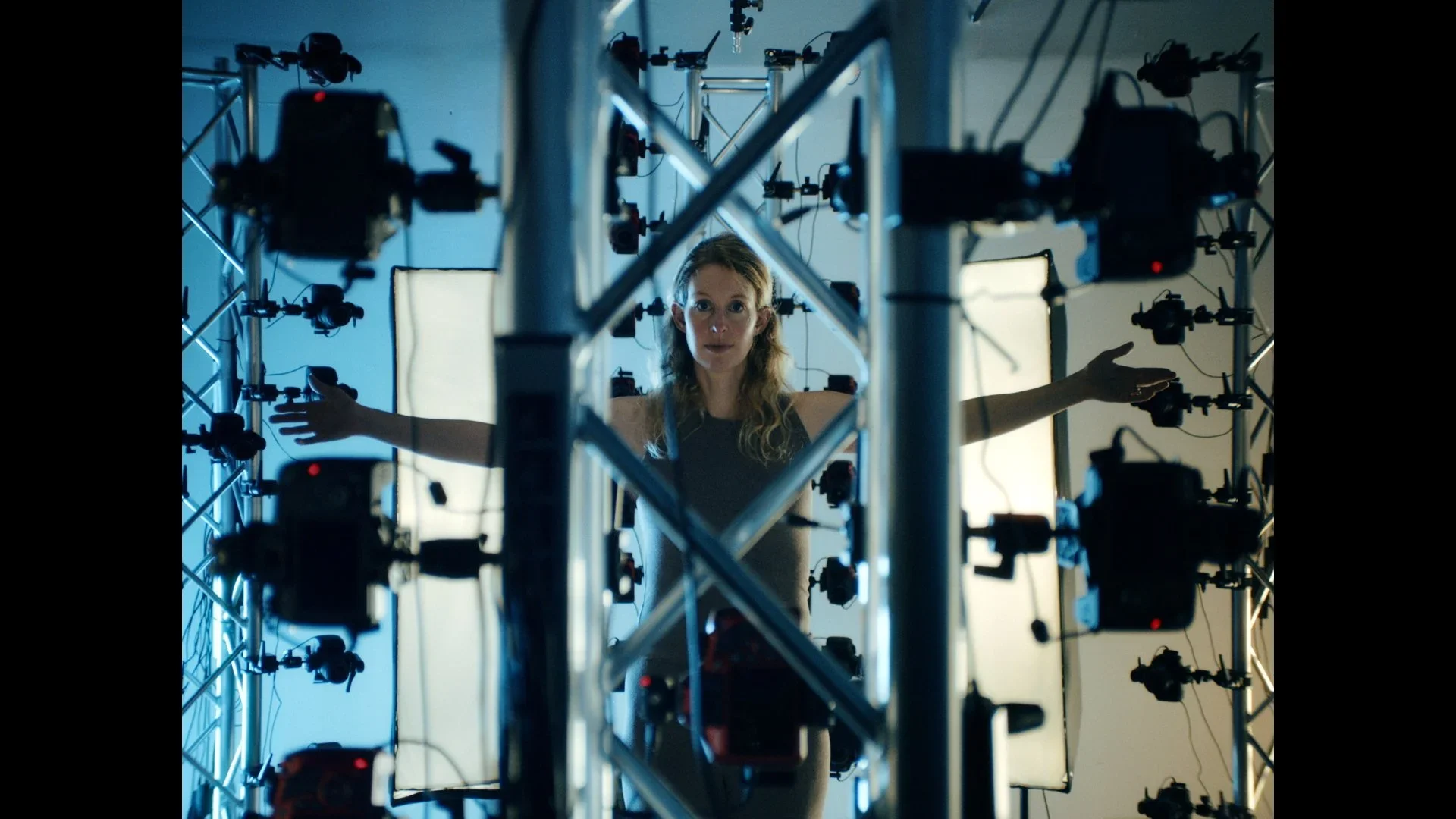
You Can See Everything plays with the unreliable narrator trope by calling out everything as unreliable. It’s ultimately driven by the impossible quest to know everything and fully understand someone, even when that kind of clarity may be impossible to reach. Characters say something that seems impossible, such as Holmes claiming she has never lied in her life; Fielder first balks at the notion, then tries to figure out how she could believe it, and finally has to consider the possibility that she is telling the truth. Fielder quickly sets his sights on Evans, especially once Holmes is in prison. It feels personal. His irritation with Evans is palpable, especially when he tries to say he understands where Fielder’s questions and feelings about Holmes come from (Fielder's hilariously exasperated “No you don’t” cuts like a knife). The film starts feeling like it is exonerating Holmes of at least some culpability after seeing what Evans has been doing in the time leading up to and while his partner is in prison. However, once Seyfried joins Fielder’s journey to present everything through re-enactments, her involvement goes further, and she leaves the film with a chilling prospect: maybe Fielder has been going easy on Holmes.
In its pursuit of transparency, the film realizes it can never fully pull off its ambition. However, it also calls attention to every documentary that dissects a subject or tries to empathize with someone. It razes the entire conceit that documentaries are honest, objective accounts of reality. It targets the entire biopic industry and movies based on real events by simply showing how impossible it is for something to be completely authentic when it is, in itself, not authentic. The fact that You Can See Everything is thrilling, hilarious, and enlightening means something was edited in a way that evokes those feelings. The movie is comprised of a healthy amount of wide shots that provide a lot of information in the frame, but what shots are being shown and when those wide shots become close-ups makes you interrogate the entire moment. Fielder can’t even accept those moments, sometimes leaving everything up for debate.
With that concern, You Can See Everything blurs so many lines and challenges so many accepted truths of documentary filmmaking that pulling any thread further would require abandoning the project. You technically can see everything, but the word “can”—much like how Holmes explains her use of the word—becomes a skeleton key and the noose with which to hang itself. Fielder and Oppenheim walk a tightrope between artifice and reality, drawing attention to that tightrope in both personal interactions and filmmaking as a whole. This is especially illuminating today, as technology blurs those lines: the film scrutinizes AI and social media, reminding us that what we see daily might not be real, and that this presentation of reality can also be used to exploit us.
When a movie is self-aware, it can be grating. You Can See Everything avoids this problem because the movie could just be someone overthinking things to the point that reality no longer feels trustworthy. It becomes more about how we approach people than specifically a film about Elizabeth Holmes. Communication in everyday life is a key reason Holmes faced the consequences she did, but it’s also what makes the film so riveting. The information isn't always new, but the way it’s communicated to viewers feels fresh. The semantics of language, both visual and written, are the foundation of Fielder and Oppenheim’s thesis. You Can See Everything is an invigorating piece of investigative journalism that digs into its subject as much as it digs into humanity's desire for more than what can be seen in the frame. An endlessly entertaining spiral from one of comedy’s most audacious filmmakers, You Can See Everything is exhilarating filmmaking that weaponizes expectations and conventions to leave you completely beside yourself.
