
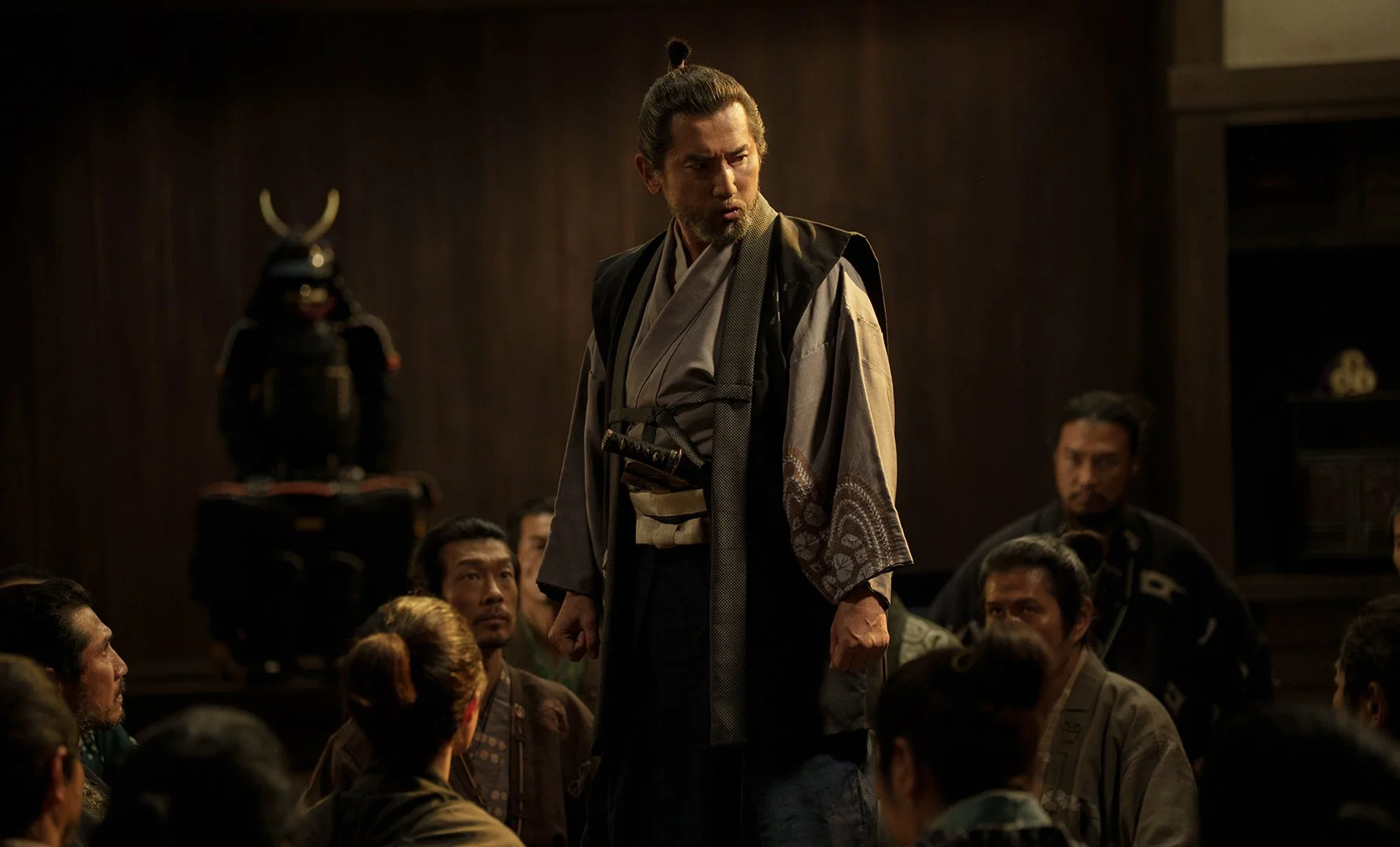
Exchanging cerebral genre fare for a tightly wound whodunit during a time of honour and customs, Kiyoshi Kurosawa’s The Samurai and the Prisoner sees the director navigate the jidaigeki film with a clever approach that channels the spirit of Akira Kurosawa and Kenji Mizoguchi through his own masterful execution. While its reveals are a little too obvious for those familiar with the genre, Kurosawa weaves an intelligent confrontation between morality and tradition. Its historical setting during a time of conflict and desperation provides fertile ground for an examination of how discord takes hold within a society, but it's through precise camerawork, intricate mysteries, and careful nuance that Kurosawa’s latest film twists a classical genre into something spellbinding and resonant.
The jidaigeki film has persisted throughout the decades, but mostly in the background in recent years. Few modern films stand out, and even fewer have left much of an impression outside of Japan. It takes an auteur like Takashi Miike or Kiyoshi Kurosawa for most jidaigeki to even have a chance to get a significant release for Western audiences. Which is what makes the few that do get released overseas worth seeking out. That the latest is done by Kurosawa—a director who has never touched the genre before—makes The Samurai and the Prisoner all the more tantalizing. Adapted by Kurosawa from the novel of the same name, written by Honobu Yonezawa, the prolific writer-director tackles a twisty mystery surrounding the siege of Arioka Castle in 1579 and the turmoil that breaks out within its walls.
Murashige Araki (Masahiro Motoki) has barricaded himself within the confines of Arioka Castle as Nobunaga Oda’s army encloses on the lord, who remains the only resistance to Nobunaga’s tyranny throughout the country. When one of the warlord’s envoys, Kanbei Kuroda (Masaki Suda), comes to deliver a message to Murashige, his expected safe return to Nobunaga is denied by Murashige, who instead holds the military strategist hostage. This transgression against samurai customs sets up a series of confrontations between Murashige and tradition that puts him at odds with his followers and the country he seeks to radicalize without violence. What starts with a samurai’s son being killed against Murashige’s wishes quickly snowballs into a series of murder mysteries that have a dash of Columbo with the regalness of a jidaigeki film.
Each mystery takes place during a season, giving Kurosawa’s film a narrative structure akin to a novel divided into parts. The only throughline is Nobunaga’s army encircling the castle, Murashige’s dedicated followers, including his wife Chiyoho (Yuriko Yoshitaka), and the constant need for Murashige to consult Kanbei on the violence happening within the castle. Those interactions between a lord and his enemy’s military strategist imbue The Samurai and the Prisoner with a respectful camaraderie tainted by blood spilled. Their conversations gradually reveal a man clinging to an ideal that no one is willing to accept—but perhaps with the help of others, he can realize this seemingly impossible goal. The dynamic between Motoki and Suda provides Kurosawa’s dialogue-heavy film with some much-needed respite as the two actors portray each tactical character with a warmth that makes their scenes feel like a refuge from the destruction above. While the film isn’t hilarious, it does have its moments of levity that help keep audiences engaged with the generally dour tone.
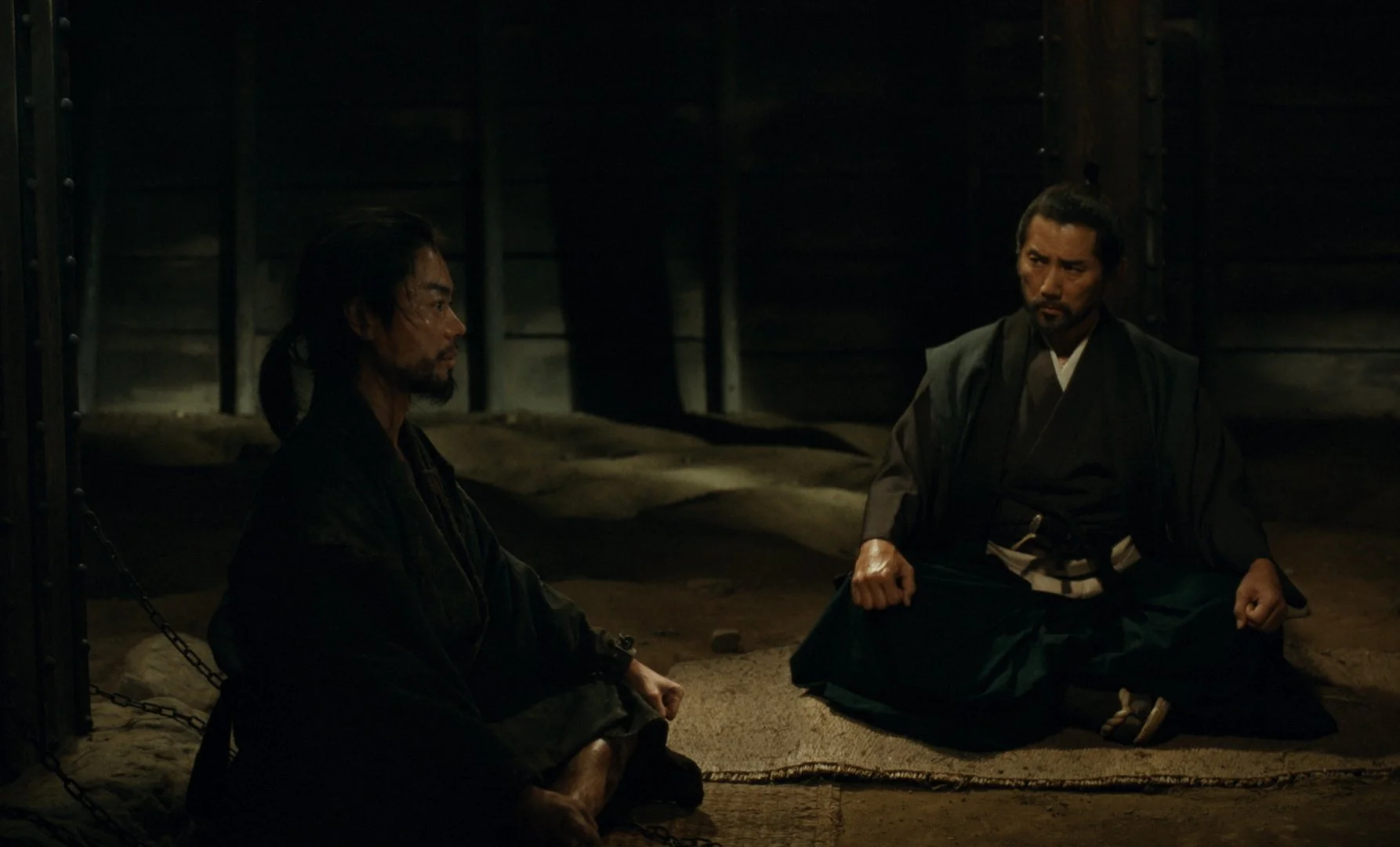
With its structure divided into discrete mysteries, the film has an uphill battle to keep each one engaging without feeling too repetitive in the themes underlying each puzzle. However, with each mysterious death comes a belief upheld by tradition that Murashige aims to strike down. Kanbei’s role in these mysteries is not just to hand Murashige the answer to deceptively simple riddles, but to force him to engage with the world order he’s threatening to upend; to understand why people behave the way they do and how the tools of warfare are not just swords and arrows. Kurosawa’s screenplay is intelligent and wordy, but it’s also occasionally playful, especially once Murashige exhausts his detective skills and is forced to turn to Kanbei.
As is par for the course with Kurosawa’s films, The Samurai and the Prisoner is a technically exquisite feature. Turning to the jidaigeki film means lavish production design and an attention to detail in every corner of the frame. It’s gorgeously shot by Yasuyuki Sasaki (who also shot Kurosawa’s mesmerizing Cloud), whose immaculate lighting and composition of a scene are at their best in the scenes between Kanbei and Murashige. Jidaigeki films sometimes rely so heavily on period accuracy that the placement of a camera becomes more an attempt to capture painstaking detail within the frame than the thematic and emotional nuance of a scene; The Samurai and the Prisoner does not have this problem. Though the film has some brief action sequences that typically demand more kinetic camerawork, the investigations and interrogations all maintain a careful, considerate movement that fully realizes Kurosawa’s vision.
A whodunit lives and dies by how much it keeps the audience guessing, but what Kurosawa’s playful series of mysteries allows is for more introspection before the reveal. There are some grandiose, larger-than-life moments that wrinkle otherwise straightforward plotting, but most of Murashige’s investigations yield underwhelming realizations. That’s less a criticism than an acceptance that when an individual is acting against the world, their ambition can sometimes strain under simple answers. The final reveal isn’t revelatory. While this does leave the film’s climax slightly disappointing, it also uncovers a deeper truth about the change Murashige wants and how much of his pursuit of it is merely a battle of attrition.
There’s a sadness underscoring Kurosawa’s screenplay (accentuated by Yoshihiro Hanno’s gorgeous score) that is impossible to shake because Murashige’s plight resonates with a darkness pervading today’s society. The Samurai and the Prisoner might exhaust audiences with its procedural elements and emphasis on conversation over action. However, its many deaths signify something more frightening than a world that allows violence: one that feels it is needed to survive. In typical Kurosawa fashion, The Samurai and the Prisoner is enriched by the strength that fear holds over characters. In a whodunit that keeps pulling the rug out from its own protagonist, the product of that fear becomes a reality impossible to ignore.
The 30th Fantasia International Film Festival took place between July 16th and August 2nd. The Samurai and the Prisoner celebrated its North American premiere on July 22nd as Fantasia’s Horizon 2026 program. The full list of films selected for the festival can be found here.
